

Choosing the best hardwood dining tables for your home comes down to multiple factors. You need to consider things like wood density, structural joinery, and table geometry, as well as practical matters like how people in your household actually eat and gather together.
Many homeowners choose white oak, ash, acacia, or American walnut for the material. These are famous for their warmth and long-term durability, but performance depends on maintenance and upkeep.
If you live in a small apartment or want a table for a small breakfast area in your kitchen, a 813- to 914-mm pedestal table is optimal. It provides sufficient seating for two to four people while maintaining surrounding walk space.
Larger homes tend to have 1829- to 2438-mm rectangular extendable tables, usually in open-plan dining areas or dedicated dining rooms.
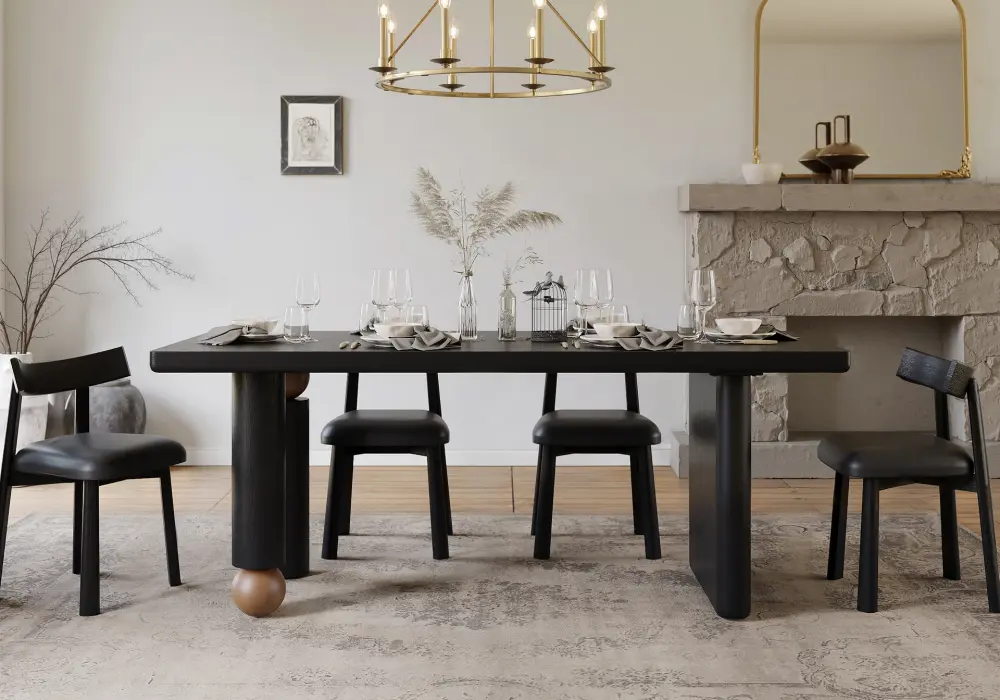
The type of wood you choose, as we'll discuss below, depends on your family setup. For children, closed-grain hardwoods like walnut and ash are best, especially when combined with protective polyurethane finishes that resist spills. Open-grain woods like oak can be great for hiding scuffs and minor alterations in texture, but they are susceptible to liquid-related damage.
Source Homary
Comparing hardwood specs, grain durability, and room style
It's worth mentioning that not all hardwoods perform the same under daily wear. While they have a reputation for being a durable option, some woods are better than others depending on the situation.
The Janka Hardness Test measures the hardness of wood species and their resistance to various forms of wear, such as scrapes and dents. Understanding these hardness measures helps you determine which type of wood is suitable for your environment.
Acacia
Acacia is a fast-growing hardwood that's become more popular in recent years because of its bright, golden, ribbon-like grain contrast and deep mahogany hues. Its Janka hardness rating is between 1,800 and 2,200 lbf, depending on the source and origin. Because of this, it's widely considered to be exceptionally hard and resistant to most forms of scratching. Many people place it in high-throughput dining rooms and even in indoor/outdoor transition spaces.
European ash
European Ash is a rarer type of wood that grows more slowly, but it's still a highly coveted option for hardwood dining tables. It has a Janka rating of 1,320 lbf so it's still a reasonable option for dining tables, although it's not as tough as acacia.
We suggest this option if you're looking for a contemporary dining table setup or a Japandi dining space. It brings resilience without the usual visual weight of other hardwoods.
White oak
White oak is a quintessential hardwood option in northern latitudes. It's one of the most durable domestic hardwoods available and has a Janka rating of 1,360 lbf.
What we particularly like about this option is its resistance to crushing force. Even if you drop a heavy weight on it, it's less likely to deform than many other woods, meaning that it can maintain more of its shape under real-world dining scenarios.
If you like subtle gray, a straight grain, and a subtle fleck pattern, then white oak is the choice for you. It works in organic, modern, and transitional living spaces.
American walnut
Lastly, you might want to consider American walnut for hardwood dining tables. People love it for its chocolate brown tones and purple undertones, along with its complex flame-like grain patterns. It has a Janka hardness rating of 1,010 lbf, so it is reasonably strong, although nowhere near the strongest option on this list.
We suggest this for modern Japan and contemporary dining rooms, especially if a deep woody tone would suit them. It may not, however, be suitable for light and airy spaces.
Hardwood dining table option comparison table
Source Unsplash - CC0 License
In this table, we take a look at different wood species and how they stack up against each other as dining table material options. We look at everything from their durability and scratch resistance to their maintenance level and even the ideal room style that would suit them most.
Wood Species | Janka Hardness (lbf) | Grain & Tone Profile | Durability & Scratch Resistance | Maintenance Level | Ideal Room Style |
American Walnut | ~1,010 | Dark chocolate brown with warm undertones; straight to wavy grain | Medium-High; handles daily meals well | Low-Medium; periodic oiling or dusting | Mid-Century Modern, Japandi, Contemporary |
White Oak | ~1,360 | Light tan to golden olive; prominent ray patterns and straight grain | High; excellent resistance to dents and heavy use | Low; simple wipe-downs with damp cloth | Scandinavian, Modern Farmhouse, Transitional |
Ash | ~1,320 | Pale cream to light straw; bold, open cathedral grain | High; flexible and highly impact-resistant | Low-Medium; keep dry to prevent grain swelling | Japandi, Minimalist, Nordic Modern |
Acacia | 1,700–2,300 | Multi-tonal gold, amber, and deep brown; expressive swirling grain | Very High; extremely hard surface | Low; resilient against heavy daily wear | Rustic, Bohemian, Industrial |
Rubberwood (Eco Hardwood) | ~960 | Light blonde to pale cream; tight, uniform grain | Medium; suitable for casual daily dining | Low; protect from direct heat and standing water | Modern Casual, Urban Apartment, Budget-Conscious |
Table sizing and room layout rules
Before you go ahead and buy a new hardwood dining table in 2026, it is well worth thinking about some practical considerations, including table sizing and room layout rules. You want a table that is going to fit snugly in your space and isn't going to impede your enjoyment of your floor plan
Follow the 914 to 1219 mm clearance rule
The first thing you want to do is follow the 914- to 1219-mm clearance rule. This says that you should have at least 914 mm as a minimum between the edge of the table and the nearest wall, door frame, or sideboard. Any less than this, and it will be hard for people to pull out their chairs and stand up. It's okay for a dining table to be in the corner of a room, but people still need physical space to sit at the table.
We recommend 1219 mm as the ideal clearance for a dining table. This provides both a space for somebody to stand up by pushing their chair out behind them and additional space for people to walk behind those already sitting at the table.
Check seating width and depth
You should also check seating width and depth at the dining table. You need to have sufficient tabletop space for each person.
For casual dining, you'll need about 610 mm of table perimeter space per person. That translates to exactly 610 mm. If there's less than this, their elbows will knock together while they eat, and that won't be comfortable for anyone.
For more formal dining, you'll need more space. Experts usually recommend 762 mm of table perimeter for sufficient elbow space. Formal dining usually involves using both a knife and a fork, which widens the individual diner's silhouette.
As for place setting depth, you'll need between 356 and 406 mm from the middle of the table. This means the table should be at least 914 mm overall so diners have space in the middle for both their own food and any serving platters.
Consider table shape and room size
Finally, you'll want to think about the shape of your table and how it will relate to the size of your room.
- Rectangular tables are obviously best for long, narrow dining rooms and create a more formal-looking space.
- Square rooms with small footprints (under 3048 mm by 3048 mm) are better suited to single-pedestal tables with the pedestal in the middle, reducing footspace interference.
- Oval and barrel-shaped tables can also be excellent choices to round off sharp corners. These can be suitable in family homes where you're worried about children running into the sides of tables and can soften the visual appearance of the table as situated in the room.
Consider daily living versus formal entertaining needs
Source Unsplash - CC0 license
Whenever you consider buying a hardwood dining table, think carefully about how you will actually use it. The type of table you buy will ultimately depend on your current lifestyle.
Families with young children are often best suited to hardwood dining tables with polyurethane finishes. Polyurethane is a durable finish that protects the hardwood while preserving its natural grain. It protects it against spills and makes the wood impermeable, so it won't warp or degrade over time, even if your kids spill milk or tomato soup on it.
You should also think about whether you need your table to have softened edges. As mentioned earlier, rounded edges can help reduce the risk of injury from sharp corners.
If you're more interested in buying a dining table for entertaining and flexible hosting, we'd recommend getting one with an extendable leaf mechanism. High-grade extension systems allow you to add extra millimeters of space to a table in seconds so you can host additional guests if required.
These tables are best protected with a penetrating oil or wax finish. These oils not only improve the appearance of the wood, but they also make it less porous and more resistant to spills.
Best hardwood dining tables of 2026. Our top picks
So we finally get to the section everyone's been waiting for: our selection of the best hardwood dining table list of 2026.
Pick 1: Best for Small Spaces & Japandi Interiors
Featured Design: Homary Japandi 813 mm Round Small Walnut Wood Dining Table
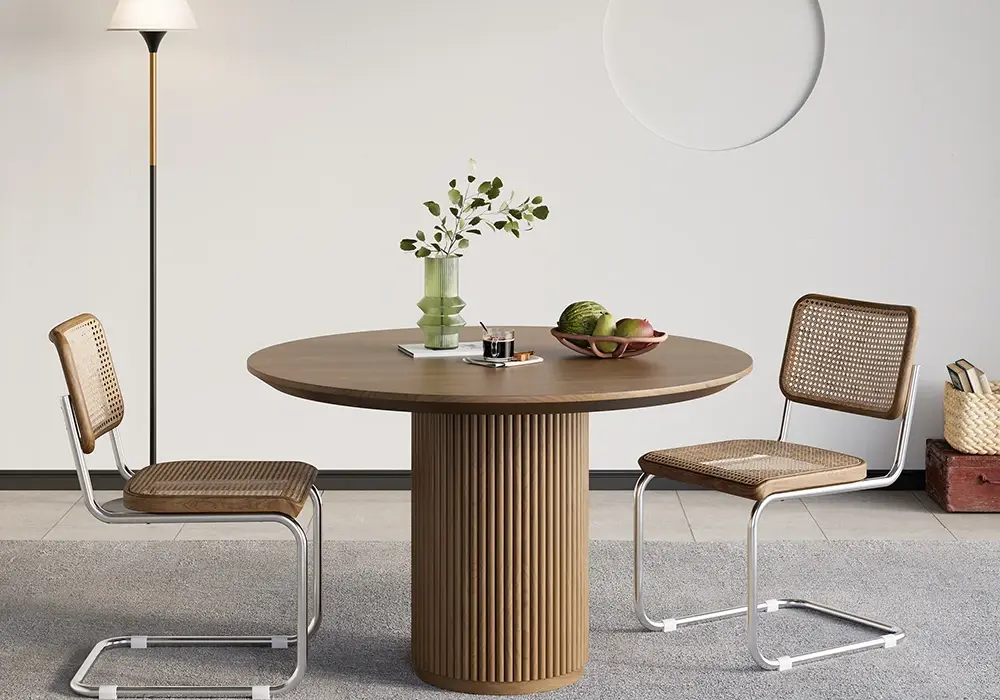
The Homary Japandi 813 mm Round Small Walnut Wood Dining Table is our top pick for small spaces in 2026. We particularly like this option because it combines a two- to three-person seating capacity with a solid walnut top and engineered support. It's perfect for city studio apartments, cozy open-concept living spaces, and breakfast nooks
The table itself is surprisingly large at 813 mm and provides a sufficient footprint without crowding the rest of the space. It also has chamfered edges for additional safety and a completely rounded finish, avoiding any sharp 90° corners.
Pick 2: Best for Family Gatherings & Flexible Entertaining
Featured Design: Homary 6-Seater Extendable Natural Oval Pedestal Dining Table
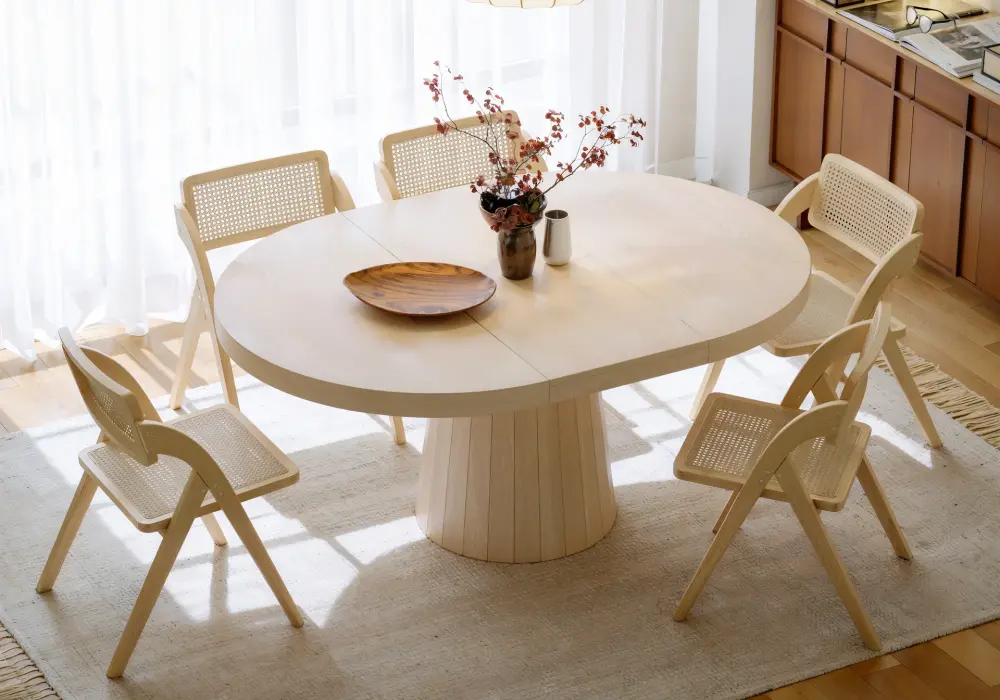
The Homary 6-Seater Extendable Natural Oval Pedestal Dining Table is made of solid ash and oak hardwood. It's large enough for 4 people and up to 8 people when extended, with a smooth-operating butterfly expansion mechanism and rounded oval end caps.
We think this table is suitable for anyone looking to bridge the gap between daily space management requirements and dinner party capacity. Because of its compact round configuration, it can sit in regular dining rooms or even extended kitchen areas, seating between 6 and 8 adults without corner posts.
Pick 3: Best for Modern Farmhouse & Rustic Spaces
Featured Design: Homary Modern Farmhouse Extendable Wooden Dining Table
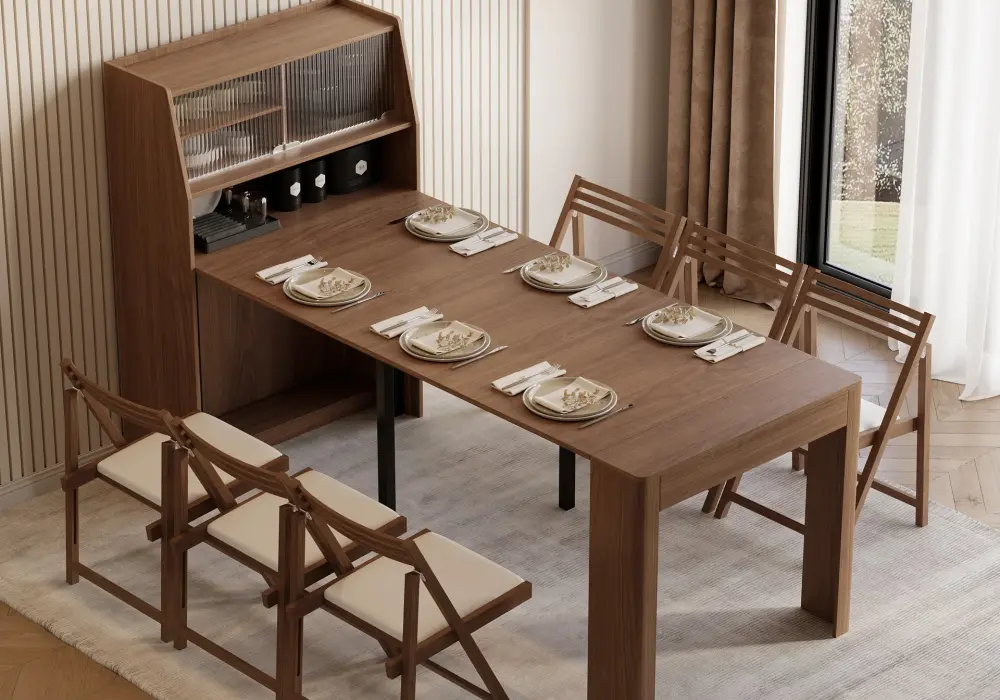
Finally, if you're looking for a modern farmhouse look, then you’ll want to opt for our Modern Farmhouse Extendable Wooden Dining Table.
This option features built-in storage directly in the table and provides comfortable seating for up to eight people. It has a mixed-material tactile appeal and a durable, scratch-resistant top with robust trestle legs. Ultimately, you'll want to use this option if you have a slightly larger dining room and frequently host family-style meals.
FAQs
How can I figure out how many people can sit around my dining table?
Usually, the manufacturer will tell you how many people the dining table is designed for. You can also figure out how many people can sit around the table by measuring the length of the perimeter on either side. Each diner needs a minimum of 610 mm of space and ideally 762 mm.
What's the best wood for a dining table that gets heavy usage?
The best woods for dining tables of heavy usage are higher on the Janka scale. Acacia is probably the best performer in this area, although walnut and oak are also good options.
How do I protect a hardwood dining table when serving hot dishes?
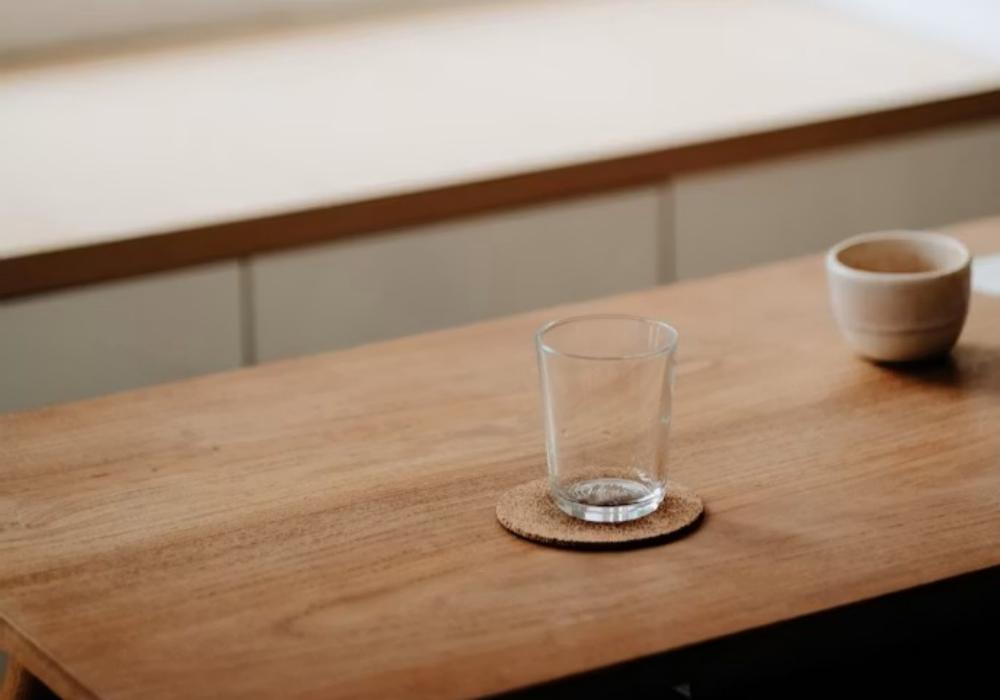
We recommend against placing hot pans directly on the table surface. Thermal shock can crack the wood and turn the lacquer cloudy. Use a wood or cork insulating mat and put it under hot ovenware. More generally, protect your table with mats to prevent scratches and higher maintenance costs.