

The formal dining room—dusty, rigid, and reserved strictly for Thanksgiving—is officially extinct.
These days, the place where we eat is the hardest working zone in the house. It’s a makeshift WFH desk on Tuesday morning. A watercolor painting station on Wednesday afternoon. And somehow, an elegant gathering spot for dinner by Friday night.
If you’re looking for a modern dining table that can keep up with this hectic world, you know the difficulty. Open a design magazine and you see row upon row of unbelievably sharp angles and razor-thin slabs of marble. I think these are works of art. But attempt to set up a laptop there, or cram 6 people around it without their knees bumping into an awkward wooden apron, and the illusion vanishes.
Fortunately, the 2026 furniture vista is finally maturing. HOSTILE MINIMALISM IS OUT. HIGH-UTILITY, DEEPLY TACTILE DESIGN IS IN. Here's exactly how to find a table that doesn't compromise its aesthetic edge but can handle your real, messy, gorgeous existence.
Table of Content
How do you combine futuristic 2026 styling with ordinary family usefulness?
It’s the mother of all tug-of-wars. You want a dining environment that stops guests in their tracks but also a surface that won’t display a watermark if someone forgets a coaster.
The artistic trend for 2026 is toward approachable sculpture. Forget straight lines. Forget cold. There’s a huge influx of organic shapes happening—soft pebbles, asymmetrical ovals, and dramatic monolithic pedestals. These pieces are eye-catching, but their soft shapes immediately make a space feel inviting rather than antiseptic.
Here is the secret: stop looking at a dining table as an isolated island. Start viewing it as the anchor for your daily rhythm. The goal isn't to build a museum exhibit in your kitchen. It’s to curate a foundation that handles a spilled bowl of cereal just as gracefully as it holds a charcuterie board and wine glasses.
What are the most stain-resistant and long-lasting modern materials?
Let's be frankly. You like the appearance of pure white Carrara marble or raw micro-cement. But you need to take a closer look at material science if you don't want to always worry about spilling your coffee.
Traditional stone is gorgeous, sure. But it is incredibly porous. It etches, it stains, and it demands constant resealing. In 2026, the smartest pivot is toward sintered stone and advanced non-porous composite surfaces. These materials are engineered under extreme heat and pressure, meaning they perfectly mimic the hyper-textured, matte look of concrete or stone while being virtually impervious to red wine, hot pans, and sharp knives.
If you want wood, avoid the thick, plastic-sounding lacquers. Instead, choose natural hard-wax oils on sustainably harvested hardwoods. These treatments retain the raw, tactile grain of the timber but also form a barrier that actively repels liquids and avoids stubborn surface scratches.
What are the spatial rules for placing a modern dining table in a small space?
Online shopping is a risky business. You find a nice broad sweeping table on the internet. You fall in love. You click purchase. All of a sudden your dining room is a high-level obstacle course merely to get through.
If you are dealing with a tighter footprint or an open-concept apartment, guessing dimensions is a recipe for buyer's remorse. You have to measure your clearances with absolute precision to keep the room breathing.
To cross-reference your space against industry-standard room layouts and clearance metrics, take a look at the dining room layouts and sizing guides published by Apartment Therapy. It emphasizes that creating a modern dining room layout involves dynamically arranging furniture, flow, and function rather than adhering to rigid guidelines in order to create a functional and comfortable place.
Table Footprints vs. Clearance Limits
Keep this quick matrix handy to ensure your dining space actually flows without feeling cramped.
Table Shape / Size | Ideal Room Dimension | Minimum Wall Clearance | Chair Push-In Radius |
Round (1067 mm - 1219 mm) | 3048 mm x 3048 mm | 914 mm all around | 610 mm |
Oval / Soft Rectangle (1829 mm) | 3353 mm x 3658 mm | 1067 mm from active walkways | 610 mm - 762 mm |
Extendable Drop-Leaf | Varies (Great for multipurpose nooks) | 762 mm near active seating | 508 mm |
Could flexible modern tables be the answer to the dilemma of multi-purpose spaces?
Is there a war between a little, intimate kitchen nook for two and a behemoth surface when the extended family descends for the holidays?
That’s where a superbly constructed extensible table just changes the game. But, and there is a big caveat, you have to check out the engineering before you buy.
Pro Tip: Check the extension mechanism
Do not purchase an extensible modern table without checking the tracks. Need metal-to-metal or synchronized ball-bearing rollers. They’re cheap, flimsy plastic tracks that will jam, stick, or go out of alignment after a few uses and convert what should be a smooth, one-person operation into a mind-blowingly frustrating wrestling match.
A properly designed modern extendable table hides its leaves like a magic trick. When it is closed, the seam is nearly invisible, maintaining crisp, uninterrupted lines across the room. When pulled open, it grants you the extra real estate you desperately need without throwing the visual balance of your floor plan completely out of whack.
How do you make the transition from dining area to multi-use floor layout seamless?
Our homes are working harder than ever. Open-concept living isn’t going anywhere, and your dining table can’t afford to be a big visual roadblock.
Instead, you’re after clean, airy designs that let natural light run right through the space and keep your sightlines totally open. You want to carve up zones in your home with strategic furniture arrangements instead of walls.
If you’re looking for a centerpiece that hits this fine balance just right, you’ll want to explore the lineup over at Homary. Their highly functional, beautifully crafted dining tables are brilliant at marrying everyday utilitarian needs with striking, sculptural elegance. Whether you need a space-saving drop-leaf design or an expansive statement piece, they focus heavily on smart pedestal placement—meaning you won’t find yourself awkwardly kicking table legs every time you sit down for a meal.
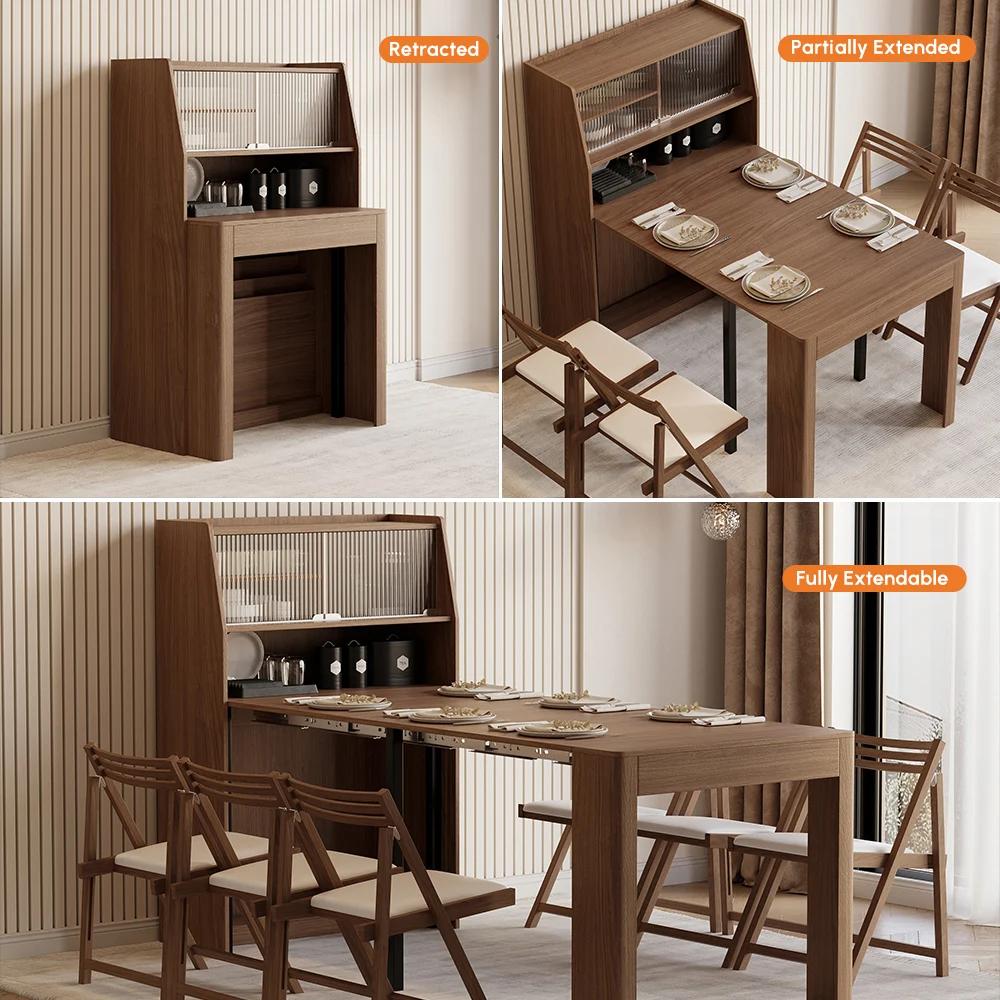
This multipurpose extendable dining table maximizes space efficiency while hosting guests by changing from small to 1801 mm to seat 8. Its creative design, which includes a built-in sideboard with plenty of storage, doubles as a useful dining table and fashionable storage option for contemporary living. Besides, Homary offers responsibly designed furniture with FSC® certification; that said, by selecting this product, you help take care of the world’s forests.
What are the expert-suggested ways to avoid spatial disasters in small spaces?
Creating a modern dining area requires a bit of design insight. Store these practical rules away to guarantee your dining room remains a pleasure to use:
- Strategy 1: Search for inset legs or central pedestals. The sturdy legs of the tables at each of the 4 outer corners restrict the number of seats you can cram around them. The central base allows the chairs to slide about freely and does not trap anyone in a corner.
- Strategy 2: Mix with low-profile, armless seats. If your eating nook is small, bulkier chairs with high arms will make the whole setup look claustrophobic. Opt for streamlined, armless styles that are tucked all the way under the table apron, instantly reclaiming your floor space.
Pro Tip: The Boxed Dimension Audit
Don’t just check the dimensions of the fully assembled table. Always verify the size of the shipping crate! A large, monolithic tabletop usually arrives in one massive slab or crate. You need to make absolutely sure that giant package can physically pivot up your stairwell, fit in your elevator, or slide through your narrow front entryway.
How Lighting and Tabletop Styling Complete the Modern Dining Experience
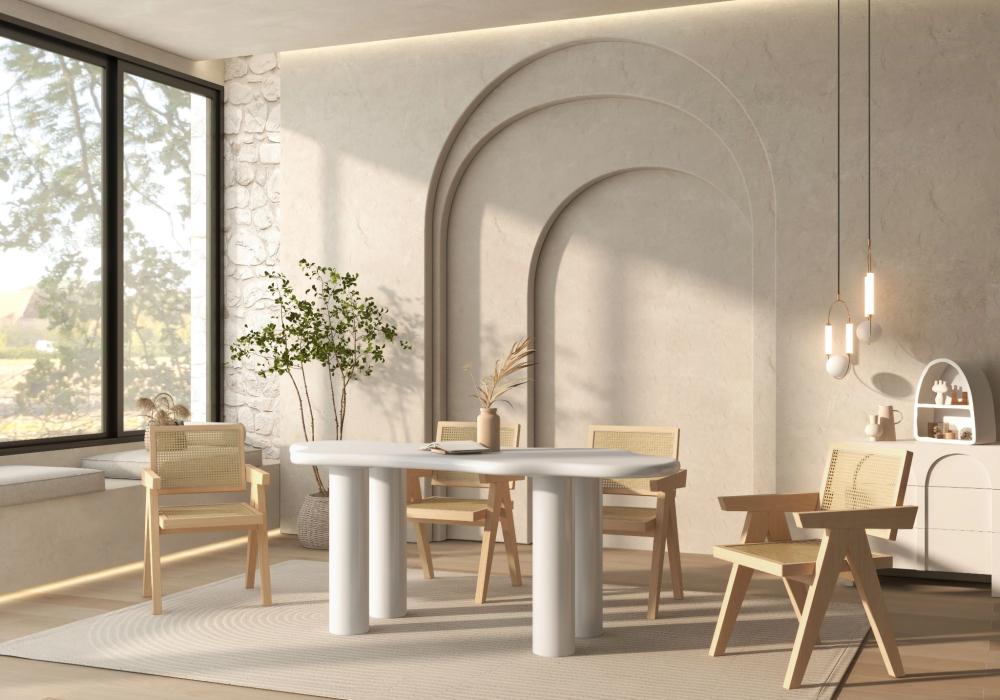
Source: Japandi style dining room design in minimalist aesthetics
A stunning table and beautifully styled chairs will lose half their impact if they are overwhelmed by poor lighting or clutter. The dining space in 2026 is not just a location to grab a fast bite; it is a significant visual anchor that demands focused, layered lighting. The days of a single blazing bulb dangling right in the middle are gone. “Modern lighting design is less about the light and more about generating atmosphere and ultimate flexibility.”
Try a bold, sculptural chandelier or a cluster of organic pendant lighting that doubles as a piece of utilitarian art. The trick is to put these overhead fixtures on dimmers so you can rapidly change the personality of the room. Bright task lighting for assisting the youngsters with their homework in the afternoon effortlessly drops away to a soft, intimate glow for your evening dinner parties. Consider also the impact low-profile table lamps could have on adjacent sideboards or the clean look of wall-mounted sconces. The light is thrown outwards rather than straight down, removing harsh shadows and creating a sense of space and welcome throughout the whole dining area.
But, aside from the lighting, keeping that modern, sleek look needs discipline in your everyday styling routine. Don’t let your lovely new table turn into an all-purpose landing spot for mail, school permission slips, or strange gadgets. The 2026 modern tables are all about expressive, tactile textures—think apparent sintered stone veins or rich matte wood grains. As such, they shouldn’t be concealed under heavy, outmoded table runners or big, intricate centerpieces.
Instead, use a brave “less is more” approach and let the innate beauty of the material shine. Keep it down to one stunning decorative element to dress the surface up for a weekend event. But beyond the lighting, achieving that modern, sleek look means being diligent with your everyday styling routine. Don’t let your lovely new table become an all-purpose landing zone for mail, school permission sheets, or strange devices. Modern 2026 tables are all about expressive, tactile textures—think exposed sintered stone veins or rich, matte wood grains. As such, they should not be concealed under heavy, antiquated table runners or big, elaborate centerpieces.
Rather, adopt a fearless “less is more” approach and let the inherent beauty of the material shine. To dress the surface up for a weekend event, keep it down to one dramatic decorative piece. Perhaps a handmade ceramic vase with a single architectural branch, or a low, asymmetrical sculptural bowl. Leaving generous expanses of empty, negative space across the tabletop, you ensure the area feels breathable, intentional, and endlessly sophisticated every single day.
FAQs: Top Questions About Dining Table Answered
Q: How do I mix and match modern tables with existing chairs?
You absolutely do not need a matchy-matchy showroom set; in fact, it looks much more curated if you don't. The trick is balancing texture and contrast. Try pairing an organic, heavily textured micro-cement table with sleek, minimalist leather or bouclé chairs. Just make sure to check the vertical math: Standard chairs should leave about 254 mm to 305 mm of clearance between the seat and the underside of the tabletop so your legs have room to move.
Q: What is the best table shape for a narrow dining room?
Oval or soft, rounded rectangular tables are your best bet. The sweeping curves of an oval table soften the rigid, boxy lines of a narrow room, making it much easier to walk around the perimeter without bumping your hips into sharp corners.
Q: Are sintered stone tables truly heat-resistant and scratch-proof?
Yes, high-quality sintered stone is remarkably resilient. Because it is non-porous, it won't absorb spilled wine or coffee, and it can easily handle a hot pot straight off the stove without scorching. Even so, it’s still smart practice to use trivets and placemats to keep the pristine matte finish looking factory-new over decades of heavy, daily use.
Q: How do I stop an extendable table from looking clunky?
Seek out modern designs where the central seam runs flush or is cleverly concealed beneath a drop-in leaf profile. Steer clear of tables featuring highly contrasting edge bands, which instantly give away the fact that the table pulls apart. A seamless, monochromatic finish ensures the silhouette reads as continuous, sleek, and entirely intentional.