

If your evenings usually end with the same argument (who gets the good spot on the couch), a reclining sofa solves the problem for everyone at once. The best reclining sofa for your home isn't necessarily the biggest or the most expensive one; it's the one that fits your room's footprint, matches how your household actually uses the living room, and reclines smoothly enough that you forget it's even a mechanism. This guide walks through the real decisions that matter, including manual or power, sofa or sectional, and fabric or leather, so you can shop with a shortlist instead of forty open browser tabs.
We'll also cover wall clearance, which is the detail most people skip and then regret once the sofa is sitting 76 mm too close to the wall, so by the end, you'll have a simple table to match your room type to the right size and features, plus answers to the questions shoppers ask most often before they check out.

What "Best" Really Means When You're Shopping for a Reclining Sofa
"Best" is doing a lot of work in that phrase, so let's define it. A genuinely good reclining sofa checks four boxes:
- It fits the room. A sofa that reclines needs open floor space behind it, not just in front of it.
- It matches how you actually sit. Solo Netflix marathons, family movie nights, and guests dropping by all call for different layouts.
- The mechanism suits your patience level. Manual recliners are simpler and cheaper; power recliners are effortless but need an outlet nearby.
- The upholstery holds up. Kids, pets, and daily use wear down cheap fabric and faux leather fast.
Keep these four in mind as you read on. Every section below maps back to one of them.
Manual vs. Power Recline: Which Mechanism Fits Your Life
This is usually the first fork in the road. Manual reclining sofas use a pull handle or a push-back mechanism, so there's nothing to plug in and nothing that can short out. They tend to cost less and weigh less, which matters if you're carrying one up a narrow stairwell.
Power reclining sofas run on a motor, controlled by a button or a small remote built into the armrest. You get a smoother, quieter recline and often a few extra conveniences layered in, like a heated headrest, USB charging, or independently adjustable footrests and headrests. The tradeoff is that each reclining section needs to sit within reach of a power outlet, and a power base adds weight and, eventually, one more thing that could need repair.
Recliners have been evolving as a distinct category of seating for well over a century. In general terms, a reclining chair or sofa is built so the backrest tilts back while a footrest rises, and most modern versions add features like an adjustable headrest or lumbar support on top of that basic mechanism.
A good middle-ground option is a sofa like the 2159 mm Genuine Leather Power Reclining Sofa with Adjustable Headrest, which pairs one-touch power recline with an independently adjustable headrest, so you get the smoother motorized action without needing to hunt for a separate remote every time you sit down.
Expert Tip: If you're on the fence, think about who's using the sofa most. Power recline is worth the extra cost for anyone with limited grip strength or mobility concerns. For a guest room or a rarely used den, manual recline does the job for a lot less money.
Sofa, Loveseat, or Sectional? Matching Shape to Your Room
Once you've settled on a mechanism, shape is next. A standard reclining sofa seats two to three people in a straight line and works well in rectangular living rooms where you need one strong seating anchor facing the TV.
A loveseat is the same idea scaled down (two recliners side by side), and it's the better call for smaller rooms, home offices, or as a second seating area in an open-concept space.
Sectionals change the math entirely. An L-shaped or U-shaped reclining sectional wraps around a corner, which uses your square footage more efficiently and gives every seat a clear sightline to the television. For rooms that host a crowd regularly, a piece like the White Modern L-Shaped Corner Sectional Sofa turns an empty corner into usable seating for five or six people without eating up the middle of the room.
If your household leans toward flexible, ever-changing layouts, moving furniture around for parties, or rearranging when you get new roommates, a modular option gives you more freedom than a fixed sectional. The 3200 mm L-Shaped Milky White Modular Sectional Sofa with Ottoman is built from separate pieces you can reconfigure as your room or your needs change, with a reversible chaise that switches sides depending on how you arrange it.
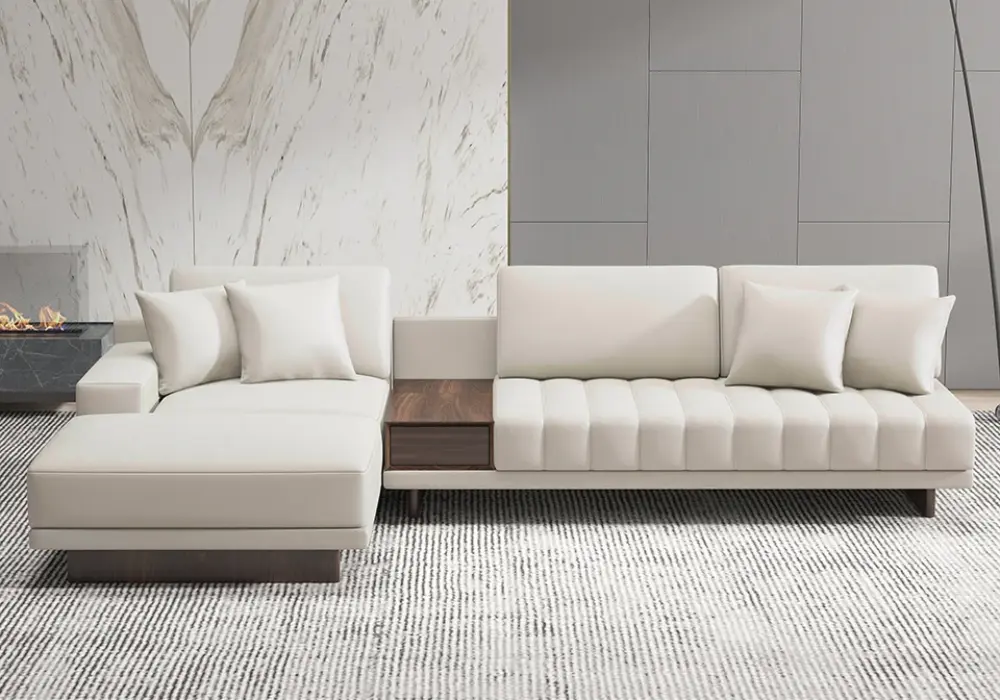
A modular sectional like this one lets you rearrange the layout instead of committing to one fixed shape.
Fabric or Faux Leather? Everyday Comfort and Upkeep
Upholstery is where personal habits matter more than trends. Fabric, whether it's a performance weave, chenille, or boucle, feels warmer against skin and tends to be more forgiving on hot days, since it breathes better than most leather alternatives. It's also usually easier on the budget.
Faux leather and performance leather wipe clean in seconds, which is a real advantage if you've got kids who eat popcorn on the couch or pets who shed. It can run warmer in summer and, depending on the grade, show scratches from claws more readily than a tightly woven fabric.
A lot of shoppers end up splitting the difference with a mixed-material sectional. The 2-Piece Yarn-Dyed Fabric and Faux Leather Reclining Sectional Sofa uses breathable fabric on the main seating surfaces with faux leather accents in higher-wear spots, which is a practical way to get the comfort of fabric without giving up all the easy cleanup that leather offers.
Expert Tip: Before you commit to a color, ask for a fabric swatch and leave it somewhere in your actual living room for a day. Lighting changes how upholstery color reads, and what looked warm-white in a showroom can look stark under your ceiling lights.
Measuring for Wall Clearance Before You Buy
This is the step most people forget, and it's the one that causes the most returns. A reclining sofa needs room behind it for the backrest to drop and, on many models, a few extra inches for the footrest mechanism to extend forward.
Here's a simple way to check:
- Measure from the wall to where the back of the sofa will sit.
- Add the manufacturer's recommended clearance, typically 102 mm to 203 mm for the backrest, depending on the model.
- Add another 305 mm to 508 mm in front of the sofa for the footrest to extend fully, unless you're buying a wall-hugger design built to recline with almost no gap behind it.
Room size matters here too. Based on National Association of Home Builders data, the average American living room measures roughly 5486 mm by 3658 mm (about 20.07 square meters), with most homes ranging from 12.08 to 39.02 square meters (source: Angi). If your room sits on the smaller end of that range, a wall-hugger recliner or a loveseat will fit far more comfortably than a full sectional.
[Diagram suggestion: a simple top-down floor plan graphic showing sofa placement with labeled clearance distances behind and in front of the seat, sized to a standard 3658 mm × 5486 mm living room.]
Comfort Features Worth Paying For
Not every extra is worth the upcharge, but a few genuinely improve daily comfort:
- Adjustable headrests: useful for anyone taller or shorter than average, since a fixed headrest rarely lands in the right spot for everyone.
- USB or outlet charging built into the armrest: small, but it means one less extension cord running across the floor.
- High-density foam cushions: these hold their shape far longer than basic polyfill and matter more than almost any other spec for long-term comfort.
- Independent recline per seat: lets one person recline fully while the seat next to them stays upright, which matters most in shared sofas and sectionals.
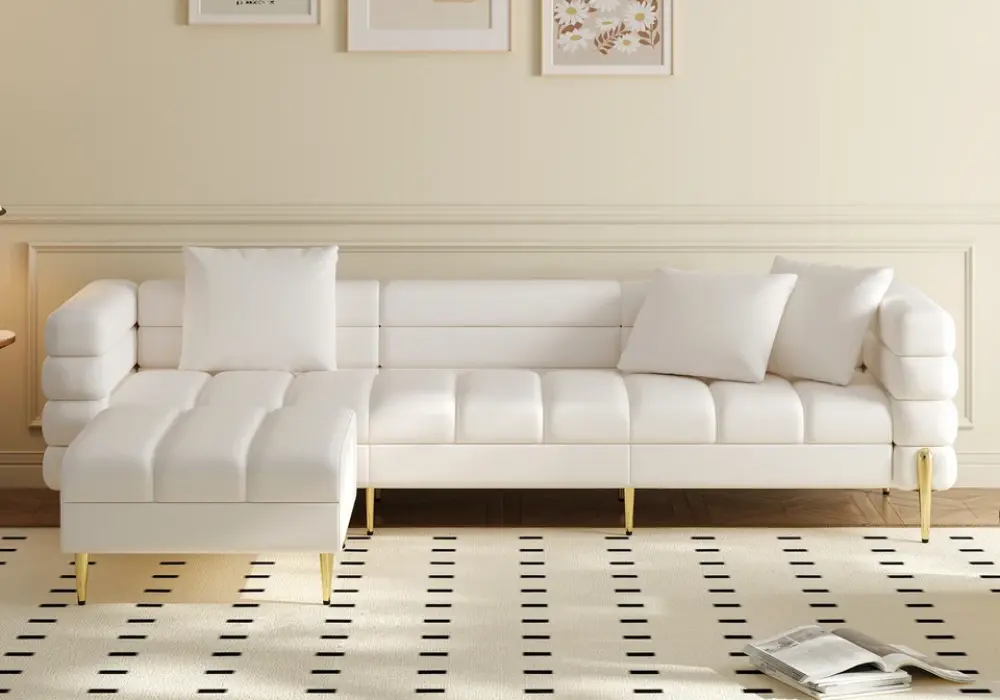
For larger households that want all of the above in one piece, something like the Axial 2311 mm Faux Leather Sectional Sofa with Ottoman pairs a chaise layout with a matching ottoman, so you get flexible extra seating without needing to buy separate furniture.
It's worth resisting the urge to add every available feature, though. Massage functions, built-in speakers, and mini fridges sound appealing in a showroom, but they add weight, complexity, and more parts that can eventually need servicing. A good rule of thumb: prioritize the features you'll use daily, like headrest position, cushion support, and easy cleanup, over the ones that sound impressive but rarely get touched after the first month.
How a Reclining Sofa Should Feel Before You Buy It
Specs only tell part of the story. Before you finalize a purchase, sit in the sofa (or, if you're shopping online, look closely at return policies and trial periods) and pay attention to a few things a spec sheet won't capture:
- Does the seat cushion support your thighs evenly, or does it dip in the middle after just a few minutes?
- Does the recline motion feel smooth, or does it catch partway through?
- Is the armrest height comfortable for resting an elbow, or does it sit awkwardly high or low?
These details are subjective, which is exactly why they matter more than any single number on a product page. A sofa can check every box on paper and still feel wrong once it's actually in your living room, so give yourself the chance to notice that before the return window closes.
Best Reclining Sofas by Use Case
Use this table as a starting point, then narrow down based on your exact room dimensions and household size.
Room Type | Suggested Size | Key Features | What to Avoid |
Small apartment living room | Loveseat or 2-seat sofa (under 1778 mm) | Wall-hugger recline, manual mechanism, slim arms | Full sectionals, deep power bases that need extra outlets |
Family room with kids and pets | Mid-size sofa or sectional (1905 mm–2794 mm) | Faux leather or performance fabric, stain resistance, sturdy frame | Delicate fabrics, exposed manual levers within reach of toddlers |
Home theater or media room | Large sectional or reclining row (2540 mm+) | Power recline, adjustable headrests, cup holders, USB charging | Sofas without independent recline per seat |
Open-concept great room | L-shaped or modular sectional (2794 mm+) | Modular configuration, consistent upholstery on all sides | Sofas designed to sit flush against a wall only |
Formal or guest living room | Standard 2–3 seat sofa (1829 mm–2286 mm) | Manual recline, refined upholstery, low-profile design | Overly casual styling, bulky power consoles |
FAQ: Reclining Sofas
Do reclining sofas need to be against a wall?
Not necessarily. Traditional recliners need clearance behind them to open fully, but wall-hugger models are engineered to recline with just a few inches of gap, which makes them a better fit for rooms where the sofa has to sit close to the wall.
How much weight can a reclining sofa hold?
It varies by model and construction, but most quality reclining sofas are built to support 135 kg to 180 kg per seating section. Check the manufacturer's weight rating if that's a concern, since cheaper mechanisms are rated lower.
Are power reclining sofas worth the extra cost over manual?
For most households, yes, if ease of use matters more than upfront price. Power recline is especially worth it for anyone who finds a pull-handle mechanism physically awkward, or for households where the sofa gets used every single day.
How long do reclining sofa mechanisms typically last?
A well-built mechanism, manual or power, generally lasts 8 to 15 years with normal household use. Power mechanisms have more moving parts and electronics, so buying from a brand with an accessible warranty is worth the extra research.
Can a sectional recliner still work in a small living room?
Yes, as long as you measure first. Modular sectionals let you choose exactly how many pieces you need, so you can start with a smaller configuration now and add a chaise or additional seat later if your space or household grows.
Final Thought
The best reclining sofa isn't the one with the longest feature list. It's the one that fits your room's actual dimensions, matches how your household spends its evenings, and holds up to daily use without a mechanism that jams or upholstery that wears thin in a year. Measure your space first, decide between manual and power based on how often the sofa gets used, and choose upholstery that matches your real life rather than a showroom photo. Then you just need to pick your favorite spot on the sofa and let it do its magic.