

Finding the perfect TV stand can feel like a puzzle. It’s not just about finding a piece that looks good; the wrong size can lead to neck strain, an unstable setup, or a room that feels visually off-balance. This guide breaks down everything you need to know—from width and height to depth and room flow—so you can choose a TV stand that’s safe, comfortable, and stylish.
Quick Answer: The Three Golden Rules of TV Stand Sizing
Before we dive into the details, here are the core principles to remember:
- Width: Your TV stand should be at least 6–10 inches (152–254 mm) wider than your TV's actual width. Aim for 3–5 inches of visible space on each side.
- Height: The center of your TV screen should be at or just below your seated eye level. This usually means a stand height of 22–28 inches (559–711 mm) for most sofas.
- Depth: The stand must be deep enough to fully support your TV's feet/stand and allow for proper ventilation. Most stands are 15–20 inches (381–508 mm) deep, but always check your TV's base dimensions.
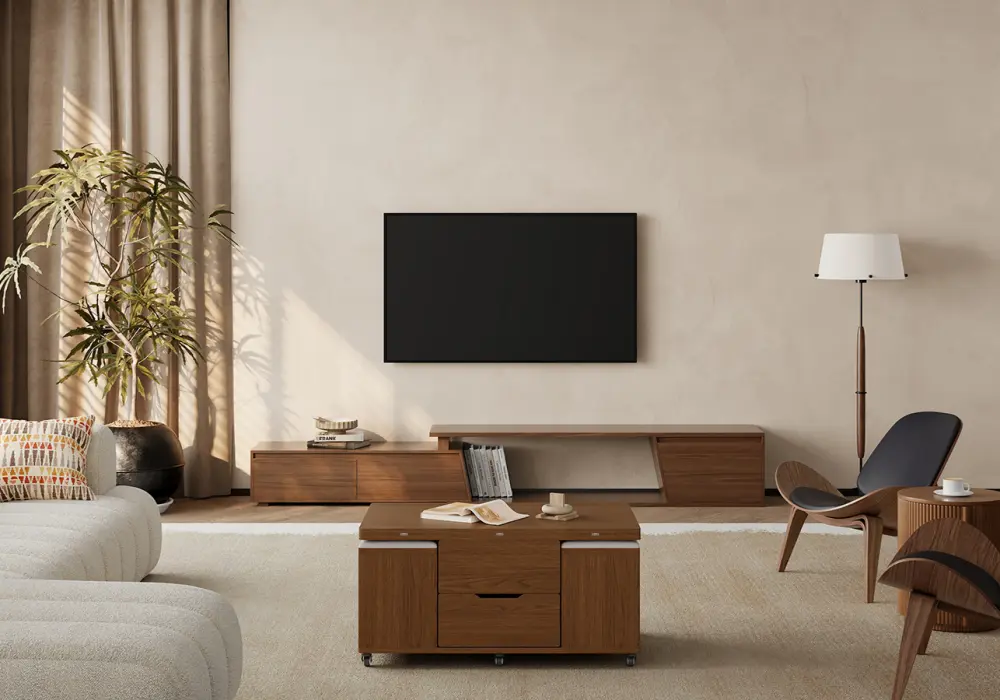
Table of Content
First, Understand How TV Size is Measured
This is the most common mistake. When a TV is labeled "55-inch," that number refers to the diagonal length of the screen, not its horizontal width.
- The Diagonal vs. Real-World Width: A 55-inch TV is roughly 48 inches wide, while a 65-inch TV is about 57 inches wide. The actual width can vary slightly by brand and bezel thickness.
- Why This Matters: If you buy a 50-inch TV stand for a "55-inch" TV, the stand will likely be too small because you're comparing the TV's diagonal size to the stand's width. Always check the actual width of your TV in the product specifications.
TV Stand Width: Finding the Perfect Fit
The width of your TV stand is crucial for both safety and visual balance.
The Minimum and Ideal Width Rule
Your TV stand should be wider than your television. Here’s the standard guideline:
Recommendation | Rule of Thumb | Why? |
Minimum Width | TV stand is at least 2–3 inches (51–76 mm) wider on each side than the TV. | Ensures the TV's base is fully supported and stable. |
Ideal / Best Look | TV stand is 3–5 inches (76–127 mm) wider on each side than the TV. | Creates a balanced, proportional look and provides space for soundbars, decor, or bookshelf speakers. |
TV Stand Size Chart (By TV Screen Size)
Use this handy chart to find the ideal width for your new TV stand. All measurements are in inches, with centimeters in brackets.
TV Screen Size | Approx. TV Width (inches) | Minimum Stand Width | Ideal Stand Width |
43-inch | 38" (965 mm) | 44" (1118 mm) | 50–55" (1270–1397 mm) |
50-inch | 44" (1118 mm) | 50" (1270 mm) | 55–60" (1397–1524 mm) |
55-inch | 48" (1219 mm) | 54" (1372 mm) | 60–70" (1524–1778 mm) |
65-inch | 57" (1448 mm) | 64" (1626 mm) | 72–80" (1829–2032 mm) |
75-inch | 66" (1676 mm) | 74" (1880 mm) | 80–90" (2032–2286 mm) |
85-inch | 75" (1905 mm) | 85" (2159 mm) | 95" + (2413+ mm) |
Pro Tip: If you plan to place large floor-standing speakers or a wide soundbar on the stand, always size up to the "Ideal Width" or even larger to accommodate them without crowding.
TV Stand Height: Saving Your Neck and Eyes
The correct TV stand height is about ergonomics. The goal is to position the screen so you can view it comfortably without tilting your head up or down for extended periods.
How to Calculate Your Ideal TV Stand Height
Here’s a simple, foolproof method:
- Step 1: Sit on your sofa in your normal viewing position.
- Step 2: Measure the distance from the floor to your eye level while seated. This is typically 36–42 inches (914–1067 mm) for most adults.
- Step 3: Measure the height of your TV (the screen, not including the stand). Divide this number by 2 to find the center point.
- Step 4: Calculate the Ideal Stand Height:
Seated Eye Level - (TV Height / 2)
Example: If your seated eye level is 40 inches and your TV is 30 inches tall (center is at 15 inches): 40 - 15 = 25 inches In this case, you should look for a TV stand that is approximately 25 inches tall.

Homary Pick: Humply Modern Warm White Leather Long TV Stand
Standard TV Stand Heights and When to Use Them
While the calculation is best, here are general guidelines:
- 22–24 inches (559–610 mm): Ideal for lower-profile sofas or if you prefer a more cinematic, slightly lower viewing angle.
- 25–28 inches (635–711 mm): The most common and versatile height, working well with most standard sofas and chairs.
- 28–30 inches (711–762 mm): Better suited for taller beds in a bedroom or bar-height seating.
Important: A common mistake is choosing a stand that is too tall. If your TV's center is above your seated eye level, you will likely experience neck discomfort over time.
TV Stand Depth: The Often-Overlooked Dimension
Depth is critical for stability and safety. A TV that overhangs its stand is a serious hazard.
Depth for TV Legs and Ventilation
- Check Your TV's Base: Find the depth of your TV's stand/feet in its specifications. Your new TV stand must be at least 2 inches (51 mm) deeper than this measurement to ensure the TV sits securely and doesn't tip forward.
- Ventilation: Electronics like game consoles and cable boxes generate heat. Ensure your TV stand has adequate depth (at least 18 inches / 457 mm) so these devices aren't pushed flush against the wall or the back panel, blocking ventilation.
TV Stand Depth | Best For |
15–17 inches (381–432 mm) | Smaller TVs (43–55 inches) with a central pedestal stand; wall-mounted TVs. |
18–22 inches (457–559 mm) | Most common. Fits larger TVs with two feet (55–85+ inches) and deeper components. |
22+ inches (559+ mm) | Large, deep TVs; multiple components; spaces where you want the TV to sit close to the front edge for a flush look. |
Factoring in Viewing Distance and Room Flow
Beyond the TV stand itself, consider how it fits into your room's layout.
- Viewing Distance: A good rule of thumb for mixed-use viewing is to sit 1.5 to 2.5 times the diagonal screen size away from the TV. For a 65-inch TV, this is about 8–13.5 feet (2.4–4.1 meters) . Ensure your room can accommodate this distance.
- Room Flow & Visual Balance: A TV stand that is too small for the wall will look dwarfed; one that is too large will dominate the space. A good guideline is to choose a stand that is roughly 2/3 the length of the wall it sits on for a visually pleasing proportion.
Wall-Mounted TVs: Does the Stand Size Change?
If you're mounting your TV on the wall, you might think the TV stand is purely decorative. However, sizing still matters.
- Stand Width: The stand should still be wider than the TV (ideally 3–5 inches per side) to anchor the space and provide a visual base.
- Stand Height: When wall-mounting, the bottom edge of the TV should be 4–6 inches (102–152 mm) above the top of the TV stand for a clean, intentional look. Use your calculated eye-level height to determine the correct wall mount position, then subtract the stand's height to find the perfect gap.

Homary Pick: Gline Modern Oval Fluted TV Stand
Common TV Stand Sizing Mistakes to Avoid
- Mistake 1: Buying based on TV diagonal size alone. Always refer to the TV's actual width and depth.
- Mistake 2: Ignoring the TV's base. A TV with widely spaced feet might require a much longer stand than the TV's screen width.
- Mistake 3: Forgetting about component clearance. Make sure the stand's shelves are deep and tall enough to hold your AV receiver, game consoles, and cable box.
- Mistake 4: Ignoring "Room Scale." In a very large open-plan room, even a correctly-sized stand might feel too small. Consider the overall furniture arrangement.
FAQs about TV Stand Width and Height
Q: Is 30 inches too high for a TV stand?
A: For most living rooms with a standard sofa, yes. A 30-inch stand will place the center of most TVs above seated eye level, causing you to look slightly upward, which can lead to neck fatigue. It is more suitable for a bedroom or a room with tall seating.
Q: Can a TV stand be smaller than the TV?
A: It is not recommended. A TV stand should always be wider than the TV. If the stand is smaller, the TV's feet may not be fully supported, creating a serious tip-over hazard. Even for wall-mounted TVs, a stand smaller than the TV looks visually unstable.
Q: How tall should a TV stand be for a 55-inch TV?
A: The ideal height depends on your seating and eye level, not the TV size. For most people, a 55-inch TV looks best on a stand that is 24–26 inches (610–660 mm) tall. Use the eye-level formula in this guide to find the perfect height for you.
Q: What size TV stand do I need for a 75-inch TV?
A: A 75-inch TV is approximately 66 inches wide. You should look for a stand that is a minimum of 74 inches wide, but an ideal width of 80–90 inches will provide a much better visual balance and allow space for a soundbar.
Q: Should a TV stand be wider than a wall-mounted TV?
A: Yes, absolutely. Even when the TV is mounted on the wall, the stand underneath should be wider (ideally by 6-10 inches total) to anchor the visual weight of the screen and create a cohesive look.
Q: How deep should a TV stand be?
A: For most modern TVs and components, a depth of 18–20 inches (457–508 mm) is ideal. Always measure the depth of your TV's base and add a few inches for safety and ventilation.