

The science of structural modification and investment on how to make a sofa more comfortable, which is an expensive, and painful irony: buying a visually appealing, high-design sofa and finding sitting on it is remarkably like perching on a wooden boardroom bench. There are far too many modern living spaces filled with sleek, minimalist couches that favor crisp lines over human ergonomics. If your primary lounging location leaves you feeling stiff, lower back strained, or numb after 20 minutes, then superficial fixes like throwing a light throw blanket over the cushions aren't going to fix the underlying physical problem.
A sofa that is too firm, too shallow, or too structurally compromised will not be saved by a quick remedy; it will take a comprehensive approach to structural engineering, textile science, and spatial adjustments. Whether you’re looking to upgrade an unpleasant frame with some science, or gearing up to invest in a luxury replacement that’s always comfy, this definitive guide breaks down the physics of actual seated comfort.
Table of Content
Why Is Your Sofa So Uncomfortable?
The feeling of lying on a rock-hard or unyielding sofa is not usually an accident, but rather an intentional production compromise. Mass-market furniture makers often use dense, low-grade polyurethane foam along with rigid, unyielding suspension systems to keep the upholstery looking clean and unwrinkled in a showroom.
When your couch doesn’t have enough sink-in depth, doesn’t support the natural curve of the lumbar spine or has cheap webbing that bottoms out under pressure the human body takes the physical stress.
To properly diagnose the discomfort, one must look beneath the fabric exterior to evaluate the core triad of modern upholstery construction: the frame, the suspension, and the cushion core. Without addressing the foundational engineering, no amount of decorative pillows will transform an inherently hostile seat into a relaxing oasis.
How to Fix Poor Support with Modular Layers
When a sofa suffers from spatial or structural deficits—such as an excessively deep seat that leaves your feet dangling or an overly firm surface that offers zero contouring—external modular intervention becomes necessary. Achieving orthopedically sound lounging requires precise physical adjustments to the seating envelope.
(For deeper insights into industry seating standards and ergonomic testing, refer to the living room furniture buying guides by Architectural Digest, which offers expert tips on how to choose a new sofa by telling you “Measure, Measure and Measure Again ➡️ Try Before you Buy ➡️ Choose a Sturdy Frame ➡️ Invest in Quality Fillings ➡️ Focus on Fabrics ➡️ Choose the Style Wisely”.)
External Support Enhancement and Comfort Matrix
Consult this engineering breakdown to determine how specific modular modifications alter your posture and pressure distribution.
Modification / Accessory | Target Deficit | Ergonomic Impact | Resulting Posture |
High-Density Foam Wedge | Slouching / Lack of lumbar support | Fills the void between back cushion and seat; aligns vertebrae. | Upright, supported, relaxed lower back. |
Inflatable Lumbar Bladder | Lower back pain / Deep seating depth | Pushes the lumbar spine forward by 51 to 102 mm. | Relieves pressure on discs; stops slouching. |
Down-Blend Overlay Pad | Extremely firm, rigid seat surface | Adds 38 mm of soft, conforming micro-cushioning. | Softens surface impact without destroying foundational support. |
Modular Footstool Extension | Short legs or restricted blood flow | Elevates lower extremities, reducing tension in hamstrings. | Semi-reclined, weightless sensation across thighs. |
Do Textile and Fill Renaissance Tactics Really Transform Stiff Lounging?
The way a couch feels to the touch is completely a function of the chemistry of its fill materials and surface textiles. A soft outer cover can’t overcome a hard, inflexible cushion core, but the right combination of fill layers can greatly lower surface tension and relieve pressure points.
A stiff sofa generally needs a localized renaissance fill to upgrade. If your cushions unzip, you may remove the monolithic foam block and place it in a channel-stitch down and feather jacket to achieve that elusive "sink in" feel. Alternatively, replacing the shredded memory foam with polyester fiberfill back cushions makes a big difference in the way it contours across the shoulder blades.
Pro Tip: The Down-Proof Ticking Rule
If you are buying or having made a feather and down wrap for your current sofa cushions, always be sure that the inside lining is made of down-proof, tightly woven cotton cambric ticking. Without this specific barrier, sharp feather quills will continue to travel through the fabric, piercing through your upholstery and irritating your skin.
Is Your Upholstery Fabric Microclimate Sabotaging Your Daily Comfort?
Thermodynamic qualities of the surface material are often ignored by consumers who find a couch unwelcoming. Even if the seat core has the ideal ergonomic density, overall comfort is negated if the outside fabric traps too much body heat, causes sweating, or feels abrasive against bare skin. The chemistry of the upholstery is what creates the microclimate of your lounge.
Synthetic microfibers and chemically treated, stain-resistant polyesters tend to have little microscopic porosity, providing an impervious barrier that blocks heat dissipation. The continuous heat build-up over time requires the person to keep changing position to cool off, causing physical restlessness and the sensation of an uncomfortable seat. Whereas high-end, breathable natural materials such as heavy-gauge, washed Belgian linen, pure uncorrected grain leather or dense, textured cotton-viscose mixes permit ambient air to pass easily through the weave.
Also, the hand-feel of the material has a great neurological effect on relaxing. Softness is kind of the whole point. If you need an extra layer (like a blanket) to make a fabric soft, it is not achieving its core design aim. When purchasing in an ultimate comfort garment, opt for heavyweight, diverse woven materials that give thermal neutrality and robust rub-count durability.
Pro Tip: Martindale Rub Test Threshold
When looking at the technical specifications for a new couch, never accept a fabric with a Martindale abrasion rating for heavy home use of less than 30,000 rubs. Anything less will pill, rough-up or otherwise abuse upholstery in short order, turning what should be a comfortable surface into an abrasive, scratchy danger that actively prevents you from sinking into it every day.
When to Replace a Sagging Frame?
There is a point in the life of any seating arrangement when stopgap fixes (such putting plywood under drooping cushions or overstuffing worn-out cases, for example) are no longer a solution. The surface changes are only a veneer on an investment that is starting to rot with structural fatigue.
A sofa is subjected to immense cyclical stress over years of daily use. If the underlying sinuous springs have snapped, the eight-way hand-tied twine has rotted, or the kiln-dried hardwood frame has cracked and begun to warp, no aftermarket cushion will restore structural integrity. Sitting on a weakened frame continues to aggravate bad posture and increase back strain. You know that you can only put on temporary fixes for so long . This avoids the sunk cost fallacy and allows for a better , scientifically engineered seating solution .
Pro Tip: Floor Clearance Assessment
Look at the bottom clearance before you spend money on structural repairs, or buy a new couch. Low-slung designs with low ground clearance trap ambient moisture, hastening the deterioration of the internal coil springs. There is enough space under the foundation frame for the structure to last a long time and for proper air flow.
How Do You Decode Engineering Specs for Long-Lasting Comfort?
When it’s time to replace a subpar piece of furniture with an investment-grade piece, your best defense against style-over-substance manufacture is to know the technical specs. Yes, the best internal architecture, built for appropriate weight distribution and longevity over many years of demanding use, is the natural consequence of real, lasting comfort.
Savvy shoppers have to check for very precise building indicators. The cushion core is made from high-resilience (HR) polyurethane foam with pocketed inner-spring coils for the perfect balance of buoyant support and pressure relief. The suspension grid is also constructed of heavy-gauge, eight-way hand-tied steel coils that evenly distribute tension throughout the whole sitting platform to avoid premature drooping in high-traffic areas.
When your daily routine demands uncompromising ergonomic support, exploring the curated collections from a trusted resource becomes essential. For instance, selecting a meticulously crafted, deeply padded sofa from Homary guarantees that your living space is anchored by advanced interior architecture. By utilizing high-density resilient foams, reinforced solid timber frames, and carefully calibrated seat-to-back angles, these premium sofas provide long-lasting comfort without sacrificing visual elegance.
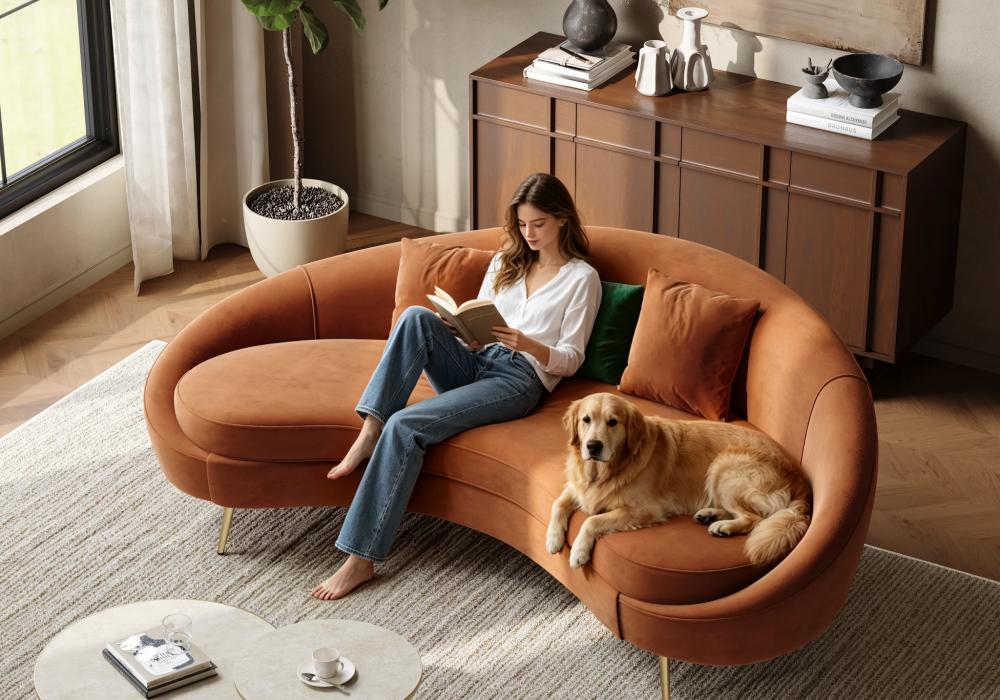
This orange curved sofa, with its exquisitely curved back, will be a stylish and contemporary focal point for any interior design. The foam-filled seat and arched back are incredibly comfortable, and the upholstery is orange velvet. This curving sofa comes in two sizes, will easily meet your demands.
Essential Rules for Your Next Sofa Purchase
The road to finding a real, comfortable long-term seating solution is one of systematic and focused evaluation. Here are proven, actionable factors to use when selecting your next living room furniture piece:
- Rule 1: Check the Net Seating Depth Be sure to measure from the front border of the cushion to the face of the backrest, not including ornamental pillows, for unobstructed seated space. Net, an upright lounge must be 533 to 610 mm deep for comfort.
- Rule 2: Request Multi-Layered Cushioning. Never buy a couch that has one solid piece of low-density foam. Foam cores can come in a variety of densities, so look for compound cores that feature foam and/or spring cores wrapped in natural down.
- Rule 3: Conduct the Frame Shake Test. Grab the outer arm of the display model and pull hard horizontally. A good grade frame will be made from kiln-dried hardwood with mortise and tenon joinery. It will be entirely rigid and will not wobble, creak or shift.
Quick FAQs: Your Top Questions Answered
Q: Can I replace the foam in my sofa cushions myself to make them softer or firmer?
Yes, absolutely. You can source high-resilience (HR) foam or high-density memory foam from specialized upholstery suppliers, cut it to the precise dimensions of your existing cushion covers, and swap out the worn-out cores. This simple modification restores or customizes the firmness of your seating without requiring a full furniture replacement.
Q: Why does my lower back hurt on deep sofas, and how do I fix it?
Deep seating surfaces prevent your back from resting against the rear frame while your feet remain flat on the floor, resulting in continuous strain on your lumbar spine. You can resolve this spatial deficit by placing an elongated, 203 to 305 mm thick foam wedge cushion directly against the backrest to shorten the seating depth and provide solid lumbar support.
Q: How do I stop my sofa cushions from sliding forward when I sit down?
Cushion migration occurs when friction strips wear out or smooth inner linings meet smooth frame decks. You can permanently eliminate this shifting by applying heavy-duty, industrial-grade adhesive-backed hook-and-loop (Velcro) strips along the bottom of the foam core casings and the underlying platform deck.
Q: What is the difference between sinuous springs and eight-way hand-tied coils?
Sinuous springs are continuous, S-shaped wires that offer uniform, linear bounce but are prone to eventual sagging over extended use. Conversely, eight-way hand-tied coils are individual, heavy-gauge steel springs meticulously secured by hand-tied twine from multiple directions. This premium construction provides superior, independent weight distribution, longevity, and luxurious support.
Q: How do I know if a sofa's frame is failing rather than just the cushions?
If you press down on the seating surface and feel a hard, uneven bottom, yet the foam cushion itself feels spongy and intact, the underlying suspension grid or deck webbing has likely collapsed. Furthermore, if the frame visibly sways, twists, or emits loud clicking noises when you rock side-to-side, the internal structural joinery has failed.