

Let's talk about the big issue: most daybeds are just twin mattresses pushed against a wall. You purchase one with the intention of creating a stylish, multipurpose lounge for your sunroom or home office, but when it's put together, it merely looks like a temporary bed for a teenage guest.
It takes more than just draping a fluffy blanket over the corner to style a daybed to seem and act like a high-end sofa. It is an exacting exercise in structural engineering, architectural symmetry, and visual weight. If you want your room to resemble a custom boutique hotel lounge rather than a guest room, you must break the visual clues of a "bed."
Here is the authoritative, step-by-step blueprint to transforming your daybed into a sophisticated, highly functional sofa.
Table of Content
The Rise of the Luxury Daybed: More Than Just a Guest Bed
The era of the purely utilitarian guest room is over. In modern interior design, square footage is a premium luxury. A room that sits empty for 340 days a year just waiting for holiday guests is a massive waste of real estate.
Enter the luxury daybed. Because they fulfill two purposes, high-end designers are increasingly using daybeds in living rooms, home offices, and open-concept lofts. During the day, they offer the deep, comfy resting area of a chaise, and at night, they become cozy sleeping accommodations. However, in order to get this look, you must regard the daybed as a sofa that you can occasionally sleep on rather than as a bed that you occasionally sit on. The distinction changes everything about how you dress it.
Dimension Check: The Exact Proportions for Sofa-Level Comfort
The number one reason daybeds fail as sofas is a fundamental crisis of depth. It is a problem of basic math and ergonomics.
A standard twin mattress is 991 mm deep. A standard, comfortable living room sofa has a seat depth of roughly 533 mm to 610 mm. If you try to sit back on a naked twin mattress, your knees will stick straight out, and your back will be slouched at a terrible angle. You have a 381 mm spatial void that must be filled.
To achieve sofa-level comfort, you must engineer a "faux backrest" that pushes the sitter forward.
The Pillow-to-Depth Ratio Guide
Reference this chart to build a structurally sound backrest that corrects the 991 mm mattress depth.
Backrest Component | Average Thickness | Deducted Depth | Resulting Seat Depth | Comfort Level / Use Case |
3 Standard Bed Pillows | 152 mm - 203 mm | - 203 mm | ~787 mm | Poor: Still too deep, feels like sitting up in bed. |
3 Euro Shams (660 mm × 660 mm) | 254 mm - 305 mm | - 305 mm | ~686 mm | Good: Great for deep lounging and reading with feet tucked up. |
Upholstered Wedge Pillows | 305 mm - 356 mm | - 356 mm | ~635 mm | Excellent: Provides firm, ergonomic lumbar support for sitting. |
Euro Shams + Lumbar Pillows | 381 mm - 432 mm | - 406 mm | ~584 mm | Perfect: Matches standard sofa depth exactly. Ideal for guests. |
The "Bedding" Ban: Swapping Sleep Sheets for High-End Textiles
If you want your daybed to look like a sofa, you must absolutely ban traditional bedding. Nothing gives away the illusion faster than a fitted cotton percale sheet with elastic gathered at the corners. It immediately signals "sleep" to the human brain.
You must switch to upholstery-grade fabrics instead. Think of the mattress as an enormous sofa cushion.
- The French Mattress Cover: Invest in a zippered, custom-fitting mattress cover composed of performance velvet, boucle, or heavy linen. The soft, rounded corners of a mattress can be transformed into the sharp, structured lines of an upscale sofa cushion with a cover that has fitted piping (welted edges).
- Monochromatic Luxury: If you can't afford a tailored cover, wrap the mattress securely in a big piece of heavyweight fabric (such as a large linen throw or a flat canvas drop cloth) and use mattress suspenders to maintain it drum-tight.
Pro Tip: Hide the Foundation
Avoid using a pleated or ruffled bed skirt if your daybed has a trundle or an exposed bottom. A nursery is where ruffles belong. Use a box-pleat, fitted linen bed skirt that matches the color of your mattress cover instead. This produces a homogeneous, monolithic block of color that resembles the sturdy foundation of a modern sofa.
Layering Like a Pro: The 3-Step Throw Pillow & Blanket Formula
Once your mattress is tightly tailored in a heavy fabric, it’s time to build the visual architecture.
Step 1: The Base Layer (Structure)
Line the back of the daybed with three large Euro shams (660×660 mm). These must be overstuffed. Use inserts that are 51 mm larger than the covers (e.g., a 711×711 mm insert in a 660×660 mm cover) so they stand rigidly upright and don't flop over.
Step 2: The Armrests (Boundaries)
A sofa has arms; a bed does not. Create visual boundaries by placing two heavy, cylindrical bolster pillows at each end of the mattress. This boxes in the seating area, visually shortening the 1905 mm length of the mattress to look more like a standard loveseat.
Step 3: The Accent Layer (Texture)
As highlighted by interior design authorities at Elle Decor when discussing modern living room trends, mixing high-contrast, tactile textures is the secret to visual wealth. Layer in 3 to 5 smaller throw pillows in odd numbers. Mix a smooth leather lumbar pillow with a chunky knit square and a patterned velvet cushion. Finally, drape a heavy throw blanket off-center, cascading casually over one of the bolsters. Never fold it perfectly at the foot of the bed.

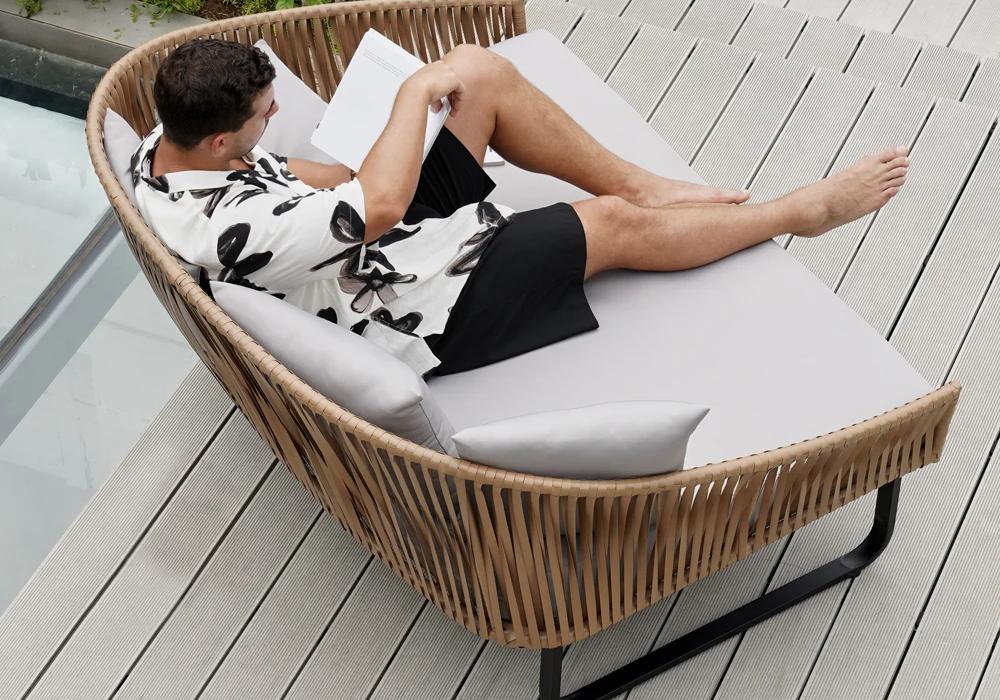
Source: Modern Outdoor Design in White with Rattan Daybed
Anchoring the Room: Styling the Surrounding Furniture and Space
A daybed floating in the middle of a room looks like a raft. A daybed anchored by surrounding furniture looks like a curated lounge. You must dress the space around the piece.
Place a large, vintage-inspired area rug partially under the front legs of the daybed to ground it. Flank it with lighting—either a sculptural floor lamp or a sleek wall sconce mounted directly above it. Bring in a heavy marble or wood C-table that slides over the mattress, giving guests a place to set a coffee cup.
This is where the foundation dictates the room's success. When you select a structurally sound, design-forward daybed from Homary, it naturally anchors the room with its premium materials. Whether you choose a mid-century walnut frame or a tufted velvet silhouette, a high-quality frame provides the authoritative presence needed to command the room just like a traditional, expensive sofa would.
Frame Matters: Working with Backless vs. Three-Sided Designs
Your styling approach must adapt to the physical architecture of the furniture.
- Three-Sided Frames: These are the easiest to style. The back panel and side arms do the heavy lifting for you. Your only job is to soften the hard wooden or metal back with the Euro shams mentioned earlier.
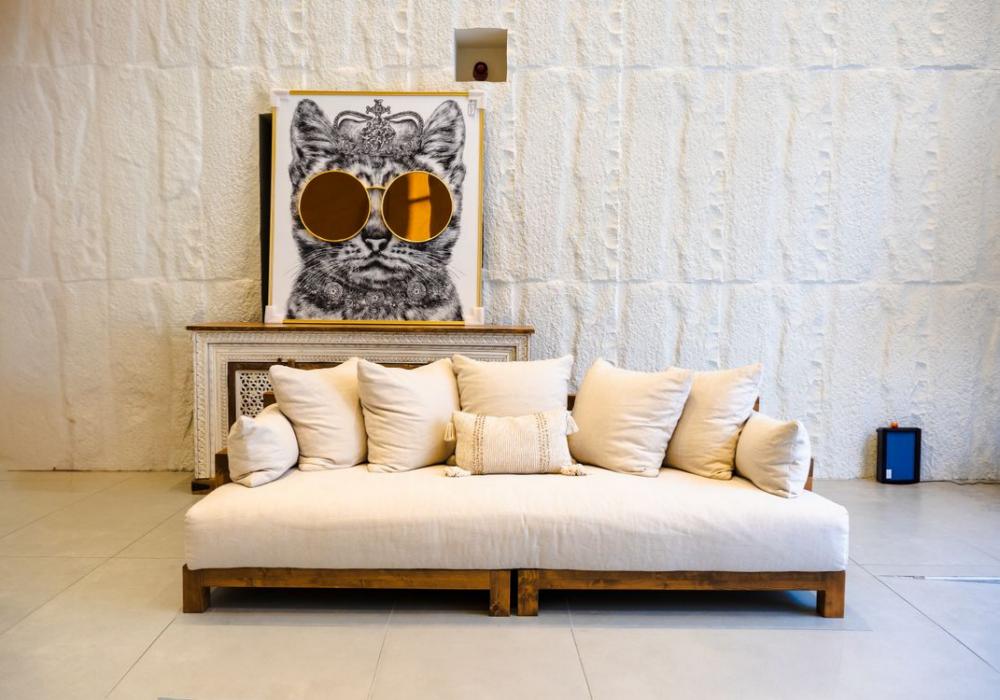
- Backless / Flat Frames: These require aggressive styling. As noted in space-saving masterclasses by Architectural Digest, a backless frame must be pushed flush against a wall. The wall becomes your sofa back. To pull this off, you must hang a large piece of oversized art or a textured tapestry low on the wall, directly behind the seating area, to visually enclose the space and serve as a faux headboard/backrest.
- Source: Pexel
Pro Tip: The Wedge Anchor
Standard throw pillows will continuously slide down the gap between the mattress and the wall when you lean on them if you have a backless daybed. To cover the whole length of the mattress, purchase a single 1778 mm upholstered wedge pillow, which is frequently offered as a headboard substitute or reading pillow. It serves as a sturdy, non-slip backrest.
Expert Tips: Transitioning from Day Lounge to Night Guest Room
The true test of a daybed is its functionality. It must look like a sofa at 3:00 PM and feel like a luxury bed at 11:00 PM. Here is how you manage the transition smoothly without exhausting yourself.
- Choose the Right Mattress Firmness: Do not buy a plush, cloud-like mattress for a daybed. When people sit on it like a sofa, all their weight is concentrated in one spot, and they will sink uncomfortably deep into a soft mattress. Buy a medium-firm to firm mattress. It provides the resistance needed for seating.
- The Hidden Topper Hack: Since a firm mattress is great for sitting but can be tough on sleeping guests, keep a rolled-up, 76 mm memory foam mattress topper in the nearest closet. When a guest stays over, roll it out over the firm mattress.
- Secret Storage: Keep the actual sleeping pillows (the ones in cotton pillowcases) hidden inside decorative, zippered Euro sham covers during the day. When it's time for bed, simply unzip them, pull out the sleeping pillows, and toss the heavy covers in the corner. You avoid having to find closet space for massive decorative pillows.
Quick FAQs: Your Top Questions Answered
Q: How do you make a daybed look less like a bed?
Ditch the standard sheets. Use an upholstery-grade, tightly fitted cover (like velvet or linen) with a zippered enclosure. Add structured bolster pillows to the ends to mimic sofa armrests, and use three large Euro shams across the back to reduce the seating depth.
Q: Should a daybed go against a wall?
Yes, almost always. Unless it has a very high, solid, and finished back panel, a daybed floating in the middle of a room looks awkward. Pushing it against the longest wall allows you to build a structured pillow backrest and anchors the piece in the room.
Q: What kind of mattress is best for a daybed used mostly as a sofa?
A medium-firm to firm mattress is essential. A soft mattress will sag under the concentrated weight of people sitting upright. If you need it softer for occasional overnight guests, use a removable mattress topper.
Q: How many throw pillows do I need for a daybed?
For a standard twin daybed, the golden rule is 3 large structural pillows (Euro shams) for the back, 2 bolsters for the arms, and 3 to 5 smaller decorative throw pillows for texture. In total, expect to use between 8 to 10 pillows to create a convincing sofa look.
Q: How do you style a backless daybed?
Push it flush against a wall. Hang a large, commanding piece of art or a mirror low on the wall to act as a visual backrest. Use a long, upholstered wedge pillow against the wall to provide solid lumbar support that won't slip between the mattress and the baseboards.
Q: Can I conceal the daybed frame or trundle with a classic ruffled bed skirt?
Avoid pleated or ruffled bed skirts since they immediately indicate "nursery" or "sleep" and detract from the appearance of an elegant sofa. Instead, to create a solid, monolithic base, choose a box-pleat linen bed skirt that is precisely the same color as your customized mattress cover.
Q: How should I drape a throw blanket on a daybed to make it look like a real sofa?
A blanket should never be laid flat at the foot of the bed or folded perfectly. Instead, drape a heavy, textured throw blanket off-center so it cascades casually over one of the cylindrical bolster armrests, adding an effortless, lived-in luxury feel.