

The Best Reclining Sofa For Small Spaces: Big Comfort, Small Footprint
Meta description: Find the best reclining sofa for small spaces with our guide to footprint, wall-hugger clearance, and recline depth so you relax without blocking the room.
Finding the best reclining sofa for small spaces comes down to one number most shoppers forget to check: the reclined footprint, not the showroom width. This is an easy thing to overlook when you’re excited about a new addition to your living room. What you should do is measure the space a sofa occupies when it is fully open, front and back, then choose a wall-hugger or adjustable-backrest design that reclines within, or very close to, its upright footprint. Getting this aspect of sofa selection right prevents your living room from becoming an obstacle course, while giving you the comfort and style you’re after. In this guide, we’ll talk about all things small footprint reclining sofas, putting you in the best position to make an informed decision.
Source Homary
Why A Reclining Sofa Belongs In A Small Living Room
There is a stubborn myth that recliners only belong in sprawling family rooms. It is easy to see why: the recliners most of us grew up with were bulky, sat 305 mm off the wall, and swallowed the room the moment it unfolded like a transformer. It’s not hard to imagine how that would be a real problem in a small apartment.
The good news is that modern reclining sofas have fixed most of those concerns. Through slimmer mechanisms, wall-hugger tracks, and backrest-only recline options, you don’t have to trade your walking space for a comfortable seat. A reclining sofa also earns its keep in a small home because it does two jobs at once: it is your everyday couch and the spot where you unwind, so you skip a separate armchair or ottoman that would eat floor space anyway. A low-profile reclining sofa can even keep sightlines open, making a small room feel larger. The trick is choosing with your room in mind and a tape measure.
Measure First: Footprint, Clearance, And Traffic Flow
Before you fall in love with a fabric, get the geometry right. Three measurements tell whether a reclining sofa fits a smaller room or makes it cramped.
Wall Length
Keep your sofa to roughly two-thirds to three-quarters of the wall it sits against; this way it feels intentional rather than wedged in. In a small room, that points you toward a loveseat or a compact two-to-three-seat sofa.
Reclined Depth
This is the measurement people miss. A sofa can be a tidy 965 mm deep upright, then grow past 1524 mm once the footrests extend and the backs tilt. Plan around the maximum in-use depth, not the resting depth. If a product page lists a reclined or fully extended figure, that is your real number.
Walkway Clearance
Designers and accessibility guidelines share one rule of thumb: keep at least 762 mm to 914 mm clear for a main path, with 914 mm as the comfortable standard for two people to pass. Drop below 762 mm and the room can start to feel choked. If you are placing your sofa facing a coffee table, then aim for 406 mm to 457 mm.
The test is simple: sketch the room, add in the sofa at its reclined depth, and confirm you still have a 762-to-914 mm lane. If the footrests open into your only walkway, the sofa is too deep for that wall. Measure the gap behind the sofa too, since even a wall-hugger needs a few inches to travel backward.
Wall-Hugger vs. Standard Recline: The Space-Saving Difference
In a small space, the recline mechanism matters more than almost anything else. There are three broad types.
Standard Recliner
A standard recliner tilts the seatback backward as the footrest lifts, so it needs clearance behind it to open. Most standard reclining sofas want 305 mm to 457 mm of space behind them. Push one too close to the wall and it will not open, or it scuffs your paint trying.
Wall-hugger
A wall-hugger (also called wall-away, zero-wall, or proximity) flips that motion. Instead of the back tilting into the wall, the seat glides forward on a track as the back reclines, so the sofa moves toward you. Many recline fully with just 76 mm to 152 mm of rear clearance. That 305 mm difference is often what decides whether a reclining sofa fits at all.
Adjustable-backrest Sofa
An adjustable-backrest sofa skips the pop-out footrest. The backrest ratchets to different angles while the seat stays put, so the recline happens inside the footprint and requires little extra clearance at the back, which makes it one of the friendliest options for tiny rooms.
One clearance people forget: the front. Even a zero-wall model extends its footrest into the room, so watch how far it reaches toward the coffee table or walkway.
Loveseat, Sofa, Or Adjustable Backrest: Matching Scale To Seat Count
With the mechanism sorted, size the sofa to how many people use it daily.
A reclining loveseat (two seats, usually 1473 mm to 1905 mm wide) is the natural pick for couples, singles, and apartments. It gives two recline positions without dominating the wall and leaves room for a slim side table. For one or two people, it is often the sweet spot.
A compact reclining sofa (three seats, roughly 1981 mm to 2235 mm wide) suits small families or anyone who hosts a guest or two, provided the wall length can carry it.
Check the seat width per person too: aim for at least 508 mm to 559 mm per seat. A three-seater with only 457 mm per cushion feels tighter than a well-proportioned two-seater, so the per-seat math beats the seat-count label.
Browse our full sofas and loveseats collection to compare widths and recline styles side by side. If the sofa also needs to host overnight guests, the sleeper sofas range is something you might want to look into.
The Small-Space Reclining Sofa Dimension Checklist
Keep this open while you shop. If a product page cannot answer these questions, ask before you buy.
Measurement | What To Check | Small-space Target | Why It Matters |
Overall width | Sofa’s total left-to-right span | 1473-1905 mm (loveseat) or 1981-2235 mm (compact 3-seat) | Should sit at roughly two-thirds of your wall length |
Seat depth (upright) | Front-to back when closed | 914-1016 mm | Determines how far the sofa protrudes day to day |
Reclined depth | Front-to-back when fully open | Confirm it leaves a 762 mm walkway | The number most shoppers forget; plan with this number |
Rear clearance needed | Space required behind to recline | 76-152 mm (wall-hugger) vs 305-457 mm (standard recline) | Decides how close to the wall you can place it |
Front extension | Keep 406-457 mm to the coffee table. | Footrests can block a path even on wall-huggers | |
Main walkway | Clear path around the sofa | 762-914 mm | Below 762 mm and the room feels choked |
Seat width per person | Cushion width per seat | 508-559 mm minimum | A “3-seater” can be tighter than a good 2-seater |
Seat height | Floor to seat cushion | 432-483 mm | Comfortable sit-and-stand height for most adults |
Doorway and delivery | Boxed and unboxed dimensions | Measure your narrowest entry | A sofa that will not fit through the door helps no one |
Three Compact-Friendly Homary Reclining Sofas to Consider
These three reach the same goal by different routes. Match the mechanism to your walls, not the other way around.
Genuine Leather With Power Recline
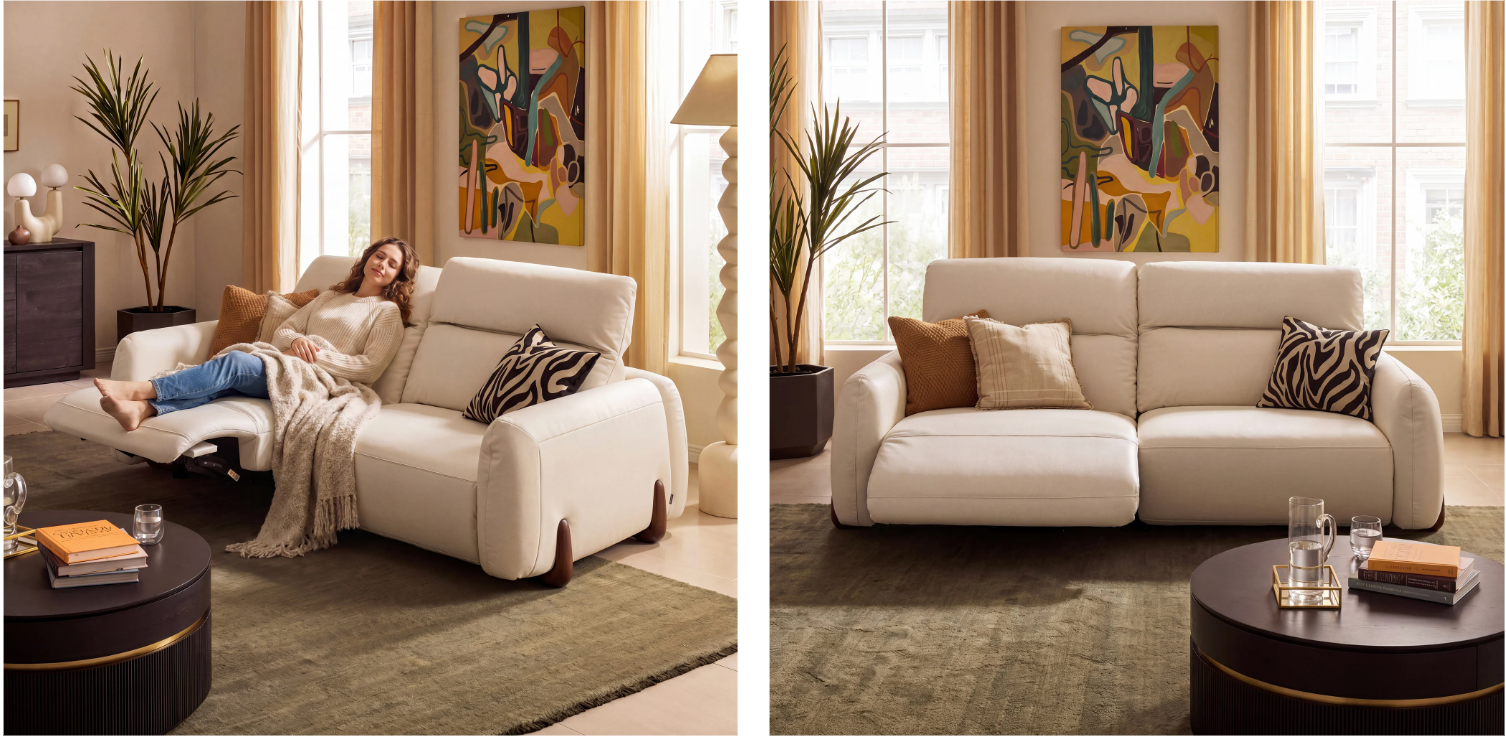
The Curva 2159 mm Genuine Leather Power Reclining Sofa with Adjustable Headrest is for shoppers who want a true recliner feel in a two-seat footprint. Genuine leather covers the contact surfaces, the headrests adjust by hand, and a power reclining seat includes built-in USB-C and USB-A ports, so your phone charges while you lounge. Walnut-finished oak legs keep it looking light rather than bulky, and the high-resilience foam holds its shape through daily use. Because this is a powered footrest recline rather than a wall-hugger, give it room front and back and check the reclined depth against your walkway before placing it near a wall.
Via Homary
The Small-space Multitasker
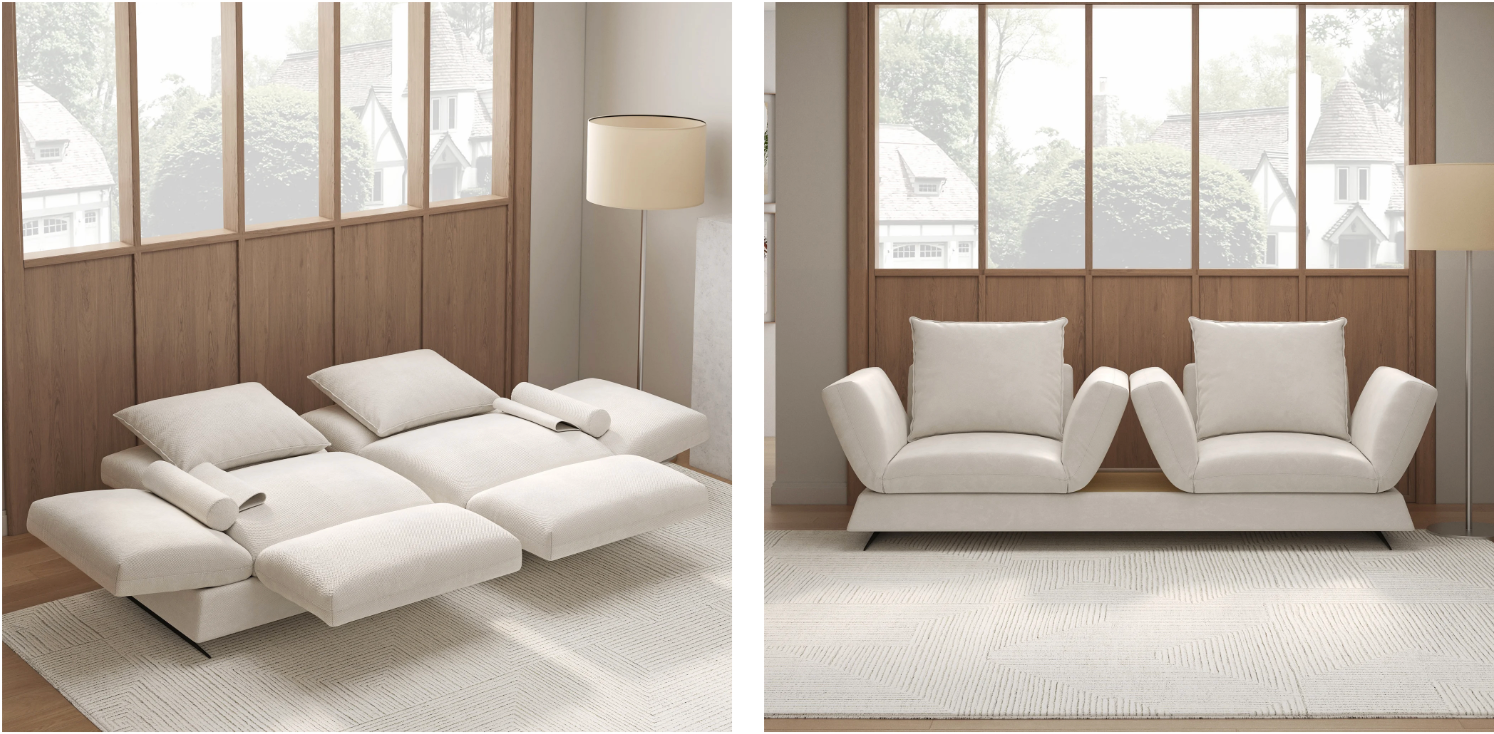
The 2134 mm Queen 3-Seater Linen Convertible Sleeper Sofa with Adjustable Backrest is hard to beat when every square foot counts. Its backrest adjusts within the sofa’s own footprint, so you recline without extra clearance front or back, then a turn and a slide convert it into a bed, doubling as your guest room. Because it opens to a queen-size bed, it hosts guests properly rather than as an afterthought, and the metal frame feels solid. The linen is pill-free and easy to clean, and the rotating base helps in awkward corners. For a studio or one-bed, this sofa wins back so much space.
Via Homary
A Wider Wall, Footprint-friendly Recline
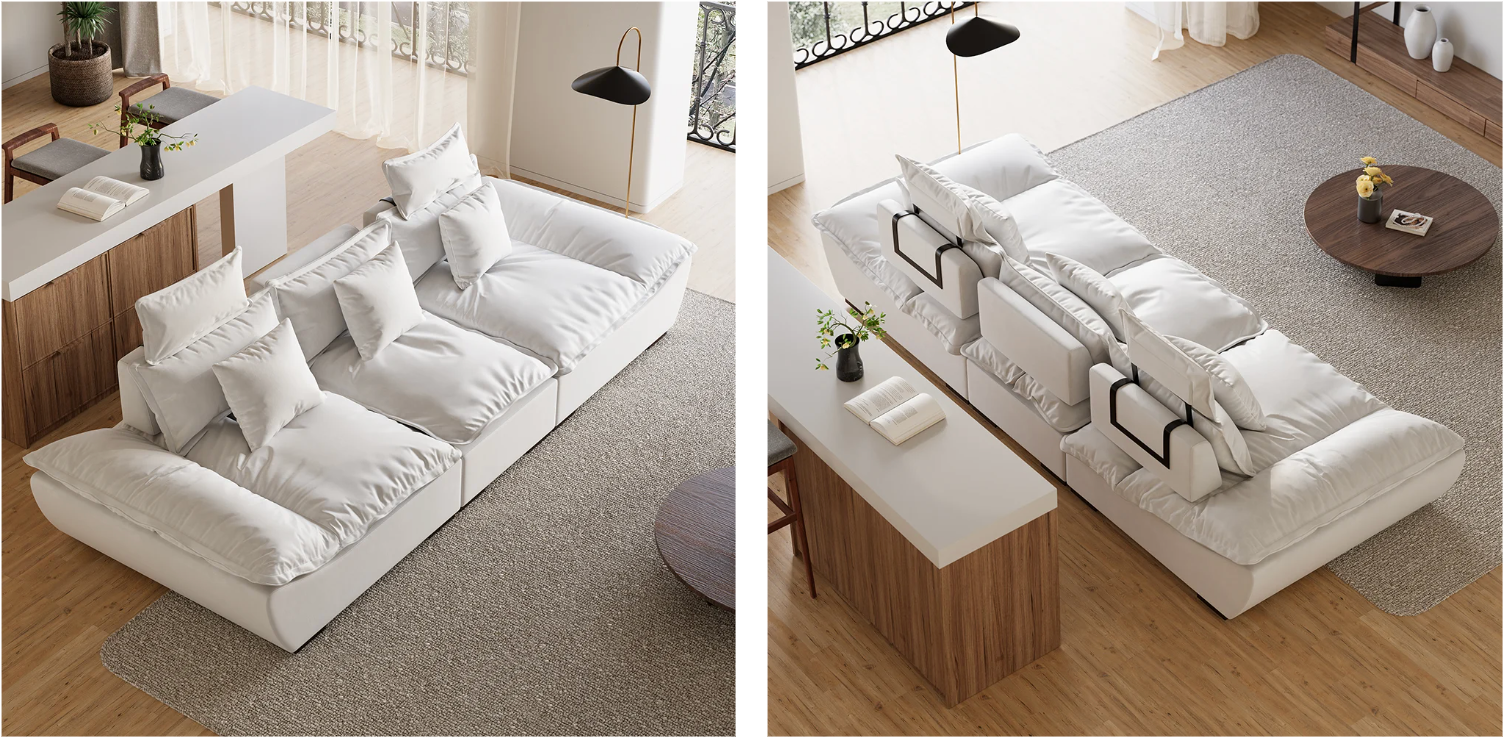
If your “small” room is really about depth, the 2779 mm White Leath-Aire 3-Seater Deep Sofa with Adjustable Backrest reclines through its backrest alone, with no footrest to stray into the path. This sofa suits a longer wall in an open-plan space where you want three full seats. Soft back cushions and the included pillows take the edge off its scale, and the Leath-Aire fabric wipes clean, making it a good choice for high-traffic open plans. Be honest about width, though: at over nine feet, this is a genuinely large sofa, so treat it as the roomier end of “small,” not an ultra tight-apartment pick.
Via Homary
Expert Tips For Choosing The Best Reclining Sofa For Small Spaces
A few pointers that separate a sofa that fits from one that dominates the room:
- Buy for the reclined footprint, not the upright one. The common regret is a sofa that measured fine closed, then blocked the walkway the first time someone reclined. If a listing omits reclined depth, ask before ordering.
- Look for a wall-hugger or adjustable-backrest design in tight rooms. The forward-glide and backrest-only mechanisms are what let you place a reclining sofa close to the wall. On a small floor plan, this matters more than color or fabric.
- Anchor the sofa with a right-sized rug. A rug under the front legs defines the seating zone and stops a compact sofa from looking like it is floating.
- Measure your doorway, hallway, and elevator, not just the room. Apartment entries often run 762 mm to 914 mm, so check boxed dimensions against your narrowest access point. A new purchase is no use if you can’t get it into your home.
- Do not push a standard recliner flat against the wall. It simply will not open fully. If you love a standard-recline model, budget the 305 mm to 457 mm of rear clearance into your layout from the start.
- Watch the front, even on a zero-wall model. Every footrest still extends forward, so keep 406 mm to 457 mm to the coffee table.
- Avoid the two classic mistakes, judging a sofa by its closed size and ignoring the walking path, and you are most of the way there.
Bringing It All Together
The best reclining sofa for a small space is not the smallest one you can find. It is the one whose reclined footprint fits your room while still leaving a decent path to move through. Nail the three measurements (wall length, reclined depth, and walkway), pick a wall-hugger or adjustable-backrest mechanism so the sofa can sit close to the wall, and size the seat count to the people who actually use it. Do that and you get real feet-up comfort in a room that still feels open, which is exactly what a small living room needs.
Frequently Asked Questions
How much space do you really need behind a reclining sofa?
It depends on the mechanism. A standard reclining sofa typically needs 305 mm to 457 mm of clearance behind it. A wall-hugger needs far less, usually 76 mm to 152 mm, because the seat slides forward instead of the back tilting into the wall. An adjustable-backrest sofa needs little to no clearance at the back. Always check the specific model.
Is a reclining loveseat better than a full reclining sofa for a small room?
For one or two people, usually yes. A reclining loveseat (1473 mm to 1905 mm wide) gives two recline positions without dominating the wall and leaves space for a side table. Step up to a three-seat sofa only if you need the extra seat and have the wall length to carry it, ideally keeping the sofa to about two-thirds of the wall.
Do reclining sofas come in apartment-friendly sizes?
They do. Compact two-seat loveseats and slim three-seaters in the 1981-to-2235 mm range are widely available, and convertible sleeper styles with adjustable backrests combine recline plus a guest bed into one footprint. Check the reclined depth and the rear clearance the mechanism needs, not just the width.
Will a reclining sofa fit through a narrow apartment doorway?
Measure your narrowest access point first, since apartment doorways commonly run 762 mm to 914 mm, then compare it against the sofa’s boxed dimensions. Some larger reclining sofas ship in sections or allow partial disassembly, so confirm before you order.
What is the best reclining sofa for a studio apartment?
In a studio, a convertible reclining sofa that also becomes a bed usually wins, because it retires the separate guest bed and frees the most floor space. Look for an adjustable-backrest recline paired with a sleeper function, and confirm it fits your walkway both as a sofa and as a bed.