

Outdoor furniture has to do more than look good on the day it arrives. In the United States, a patio set may face intense summer UV exposure, heavy rain, coastal salt air, humidity, freezing temperatures, or rapid changes between hot days and cool nights. The furniture that holds up best is therefore not defined by one material alone. Long-term performance comes from the combination of a weather-resistant frame, durable finishes, outdoor-rated fabrics, quick-drying cushions, and construction designed for repeated exposure.
For shoppers, this distinction matters. A relatively inexpensive patio set that needs replacement after two or three seasons can cost more over time than a better-built set designed for long-term outdoor use.
If you are comparing outdoor sofas, sectionals, lounge chairs, or dining sets, focus on three questions: What is the frame made from? How well does the upholstery handle sun and moisture? And what does the warranty actually cover?
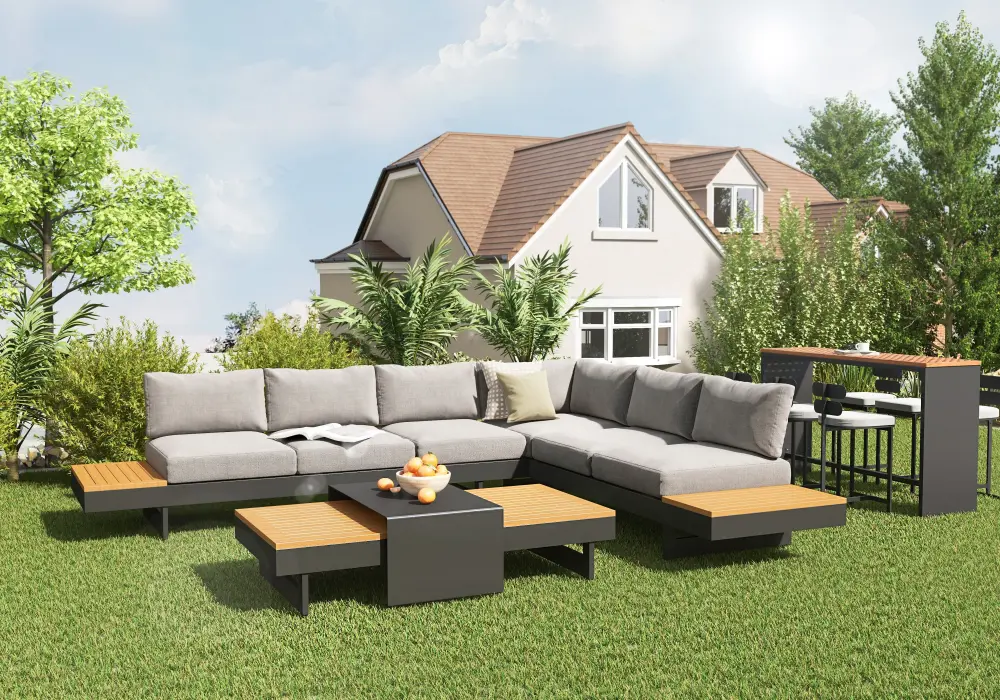
Source Homary
The Most Durable Outdoor Furniture Materials, Compared
For demanding outdoor environments, three materials consistently deserve attention: powder-coated aluminum, teak or other high-quality hardwoods, and HDPE/resin wicker. Each handles weather differently, so the best choice depends on your climate and how much maintenance you are willing to perform.
Powder-Coated Aluminum
Powder-coated aluminum is one of the most practical choices for modern patios. Aluminum does not rust like ordinary steel, and its relatively low weight makes furniture easier to reposition or store seasonally. A quality powder coating adds another protective layer against moisture, UV exposure, and everyday wear.
However, "aluminum" alone does not guarantee durability. Examine the frame construction, weld quality, coating consistency, and hardware. Poorly finished welds can become weak points, while thin or poorly bonded coatings can chip and expose the underlying metal.
Aluminum is particularly useful for poolside patios, humid climates, and contemporary outdoor living spaces where homeowners want a clean appearance without frequent refinishing.
Teak and High-Quality Hardwood
Teak remains popular because its natural oils help it withstand outdoor moisture and temperature changes. High-quality teak can remain structurally stable outdoors for many years with appropriate care.
Its appearance changes over time, however. Untreated teak gradually develops a silver-gray patina as it weathers. That does not necessarily mean the wood has failed; the underlying structure can remain sound. Homeowners who want the original golden-brown appearance will need a more active maintenance routine.
Kiln-dried, properly constructed hardwood can also perform well, but wood quality and construction matter considerably. Avoid assuming that every wooden patio set has the same weather resistance simply because it is labeled "solid wood."
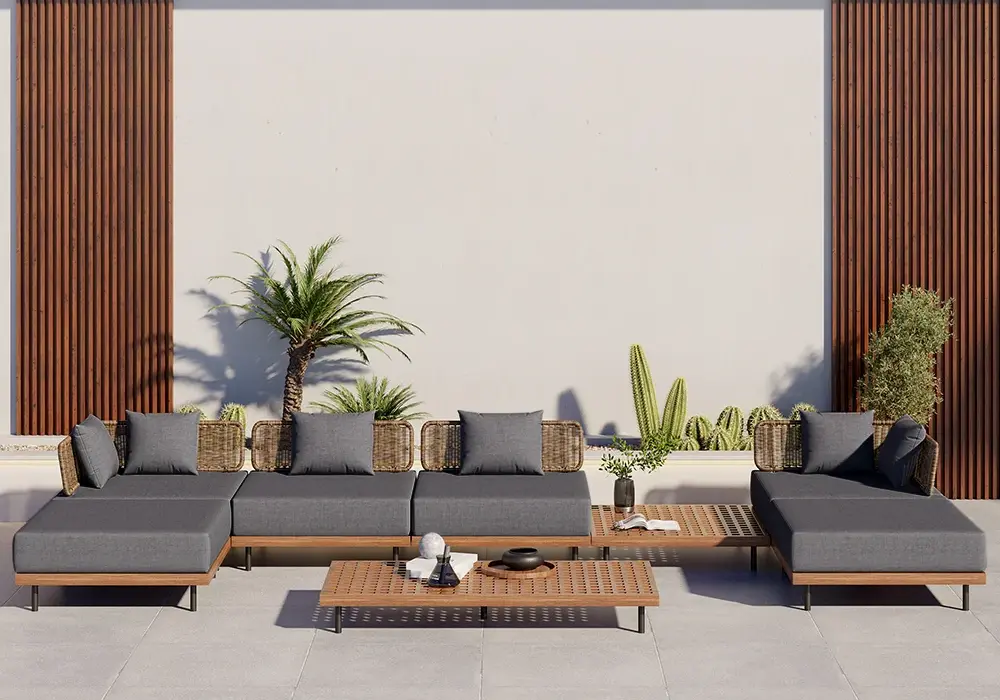
Source Homary
HDPE and Resin Wicker
HDPE, or high-density polyethylene, is another strong option for outdoor furniture, particularly when used as a synthetic wicker material over a suitable frame. Quality HDPE resists moisture and does not absorb water like natural fibers.
It is also less vulnerable to cracking and rotting than many inexpensive outdoor materials. The important word is quality. Cheap recycled plastics or low-grade synthetic wicker may become brittle, discolor, or degrade faster under intense UV exposure.
Material | Rain & Humidity | UV Resistance | Temperature Changes | Maintenance |
Powder-coated aluminum | Excellent | Very good with quality coating | Excellent | Low |
Teak | Excellent | Excellent | Excellent | Low–moderate |
HDPE/resin wicker | Excellent | Very good with quality resin | Very good | Low |
Ordinary steel | Poor without protection | Moderate | Moderate | High |
Pine/softwood | Moderate | Moderate | Moderate | High |
Low-grade plastic wicker | Poor–moderate | Poor–moderate | Poor–moderate | Moderate |
Short-lived options are worth understanding too. Untreated pine can absorb moisture and deteriorate, ordinary steel can rust, and inexpensive plastic wicker can become brittle after repeated UV exposure. The cheapest option is not necessarily the lowest-cost option over a decade.
Sun-Proof, Mold-Resistant Cushions and Outdoor Fabrics
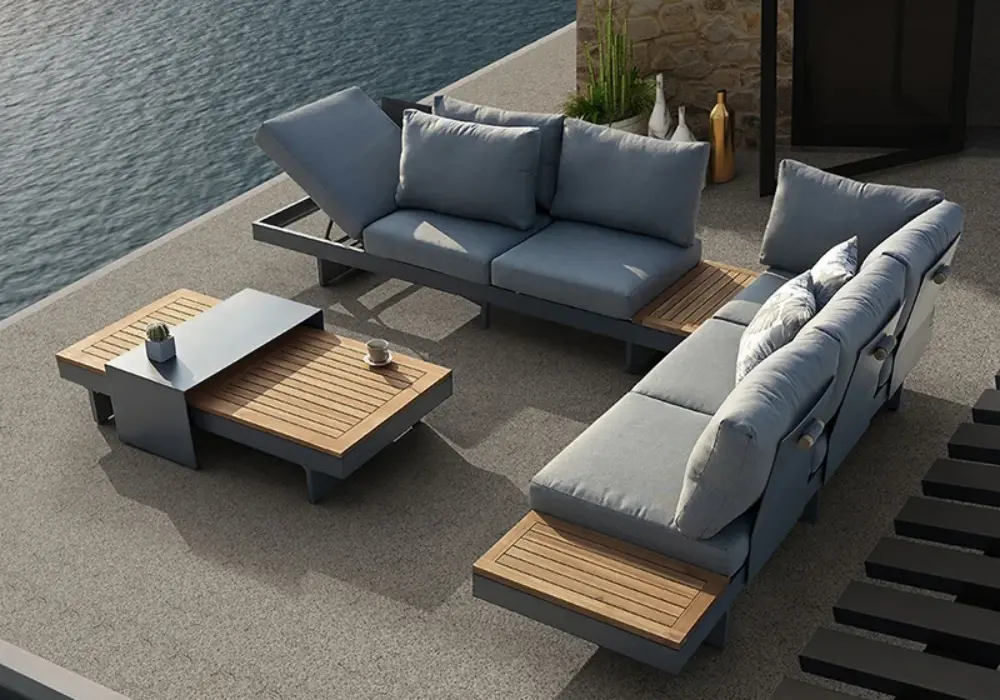
Source Homary
The frame may last for years while the cushions fail much sooner. For many outdoor furniture sets, upholstery is the component most exposed to direct sunlight, rain, condensation, food spills, and humidity.
When comparing fabrics, look beyond the phrase "outdoor fabric." Solution-dyed acrylic, olefin, and performance polyester or recycled PET fabrics can offer very different levels of UV stability, moisture resistance, cleanability, and long-term performance depending on their construction and treatment.
Solution-dyed acrylic is especially valuable for high-exposure seating because the color is incorporated into the fiber rather than simply applied to its surface. High-performance outdoor fabrics can therefore maintain their appearance better under prolonged sunlight.
For shoppers, the construction of the cushion is just as important as the fabric.
Look for:
- UV-resistant or solution-dyed outdoor fabric
- Water-resistant or water-repellent upholstery
- Mold- and mildew-resistant construction
- Quick-drying cushion foam
- Breathable or ventilated cushion bases
- Drainage channels or mesh bottoms
- Removable covers with durable zippers
- Washable or replaceable covers
These details matter in real American weather. A cushion that becomes saturated after a summer storm can remain damp through the night, especially in humid regions. Repeated moisture exposure creates a much greater mold and mildew risk than an occasional rain shower.
High-performance fabrics are designed specifically to reduce these problems. For example, Sunbrella states that its outdoor upholstery fabrics are fade-resistant, UV-resistant, water- and stain-resistant, and resistant to mold and mildew. Its standard upholstery warranty is five years for specified performance issues including color and strength loss under normal use and exposure.
That does not mean outdoor cushions should be left permanently saturated. Even the best fabric performs better when cushions can drain and dry efficiently.
For full-time outdoor furniture, a performance-fabric cushion system is therefore often a better investment than simply choosing a fashionable color. The goal is to reduce the number of times you need to bring cushions inside, replace faded covers, or deal with moisture-related deterioration.
Rust-Free Metal Frames and Build Features for Harsh Climates
"Rust-free" should never be treated as a complete description of outdoor furniture quality. The frame material is only one part of the equation.
Aluminum itself does not develop the same type of red rust associated with ordinary steel, but aluminum can still oxidize. The quality of its protective coating and the construction of the frame determine how well it handles repeated exposure.
Pay particular attention to:
- Welded joints and corners
- Powder-coating quality
- Frame-wall thickness
- Stainless or corrosion-resistant fasteners
- Drainage holes
- Adjustable feet
- Connections between frame components
For coastal homes, these details become even more important. Salt air can accelerate corrosion on exposed metal hardware and lower-quality finishes. A patio in Florida or coastal California therefore needs a more demanding material checklist than a covered backyard in a dry inland climate.
Stainless steel can provide excellent corrosion resistance, although the grade matters. Galvanized steel can also perform well when its protective zinc coating remains intact, but exposed cuts, scratches, and damaged areas can become vulnerable.
Powder-coated aluminum remains attractive for coastal and humid environments because it combines corrosion resistance with relatively low maintenance. But the best result comes from quality aluminum + durable coating + corrosion-resistant hardware, rather than from the frame material alone.
Wind is another overlooked consideration. Lightweight furniture is convenient to move, but very light pieces can become unstable during storms. For exposed patios, consider heavier bases, wider footprints, adjustable feet, locking components, or furniture designed to be secured together.
A good outdoor chair should be easy enough to reposition during normal use but stable enough that an ordinary gust does not immediately overturn it.
Long-Lasting Brands, Warranty Coverage, and Cost-Per-Year Value
Price is a poor shortcut for judging outdoor furniture durability. A better approach is to evaluate the expected cost per year.
For example, imagine two outdoor sectionals:
Option | Purchase Price | Expected Service Life | Approx. Cost/Year |
Budget set | $1,200 | 3 years | $400/year |
Better-built set | $2,400 | 8 years | $300/year |
Premium set | $3,600 | 12 years | $300/year |
These are illustrative calculations rather than guaranteed lifespans, but they demonstrate the principle: divide the purchase price by realistic expected years of use.
Warranty coverage provides another useful signal. Do not stop at "10-year warranty." Check what the warranty actually covers.
A frame may have a long warranty while fabric and cushions have substantially shorter coverage. Sunbrella, for example, currently lists a five-year limited warranty for its standard upholstery fabrics, while certain specialty fabric categories have different warranty periods.
When comparing brands, ask:
Warranty Area | What to Check |
Frame | Rust, structural failure, weld failure |
Finish | Peeling, cracking, coating failure |
Fabric | Color loss, strength loss, abrasion |
Cushions | Foam deterioration or manufacturing defects |
Hardware | Corrosion and component failure |
Replacement parts | Availability after the original purchase |
Labor | Whether repair or reupholstery labor is included |
A strong warranty does not prove that furniture will last forever, but unclear warranty language should make you more cautious.
Also consider whether the manufacturer sells replacement cushion covers, cushion cores, hardware, legs, or other components. A sectional that can be repaired piece by piece has a major long-term advantage over one that must be completely replaced after one component fails.
Low-Maintenance Care, Off-Season Storage, and Repair Strategy
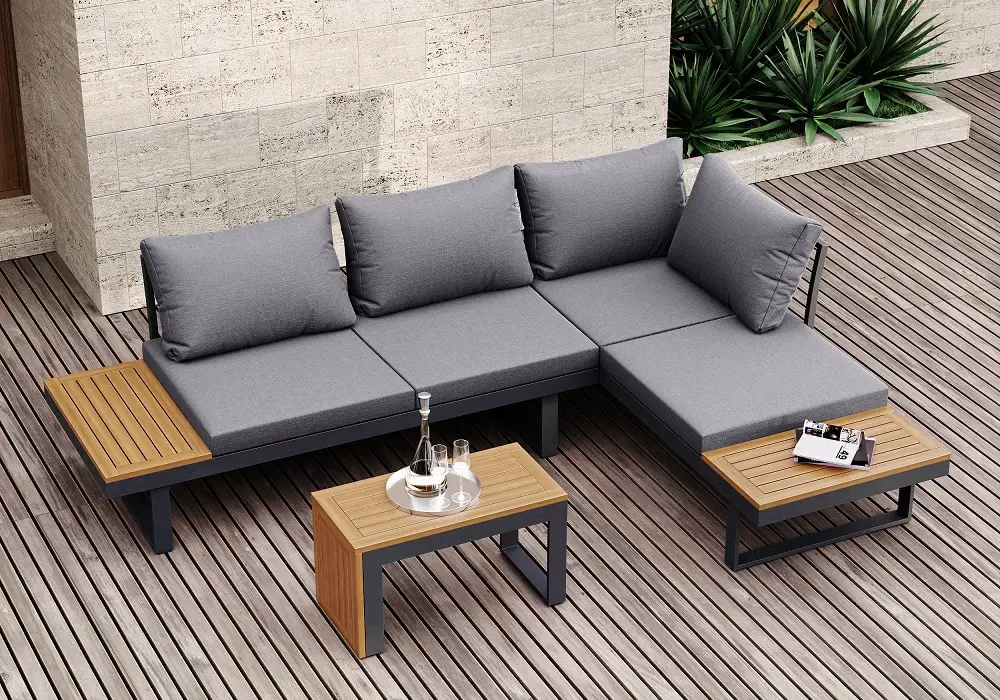
Source Homary
Even the most durable outdoor furniture benefits from simple maintenance. The objective is not to turn your patio into a maintenance project; it is to prevent small problems from becoming expensive ones.
For most outdoor furniture, routine cleaning with water and a mild, manufacturer-approved soap is preferable to aggressive chemicals. A practical schedule is to rinse exposed furniture periodically during the active season and perform a more thorough cleaning every few weeks or whenever pollen, bird droppings, tree sap, or food residue accumulates.
Avoid allowing organic debris to sit on performance fabric. Dirt, pollen, and moisture can create conditions where mildew becomes easier to develop. Sunbrella similarly notes that mildew can grow on accumulated dirt and organic matter and recommends routine cleaning.
Cushions should also be designed to drain. After heavy rain, tilt or stand cushions so water can escape rather than leaving them flat on a non-breathable surface.
In northern climates, winter presents another challenge. Freezing water can expand inside cracks, seams, or drainage areas. If you have indoor storage, moving cushions and smaller pieces inside is the safest approach. If indoor storage is limited, use breathable, properly fitted covers rather than wrapping furniture in completely airtight plastic.
Stackable chairs are particularly valuable when seasonal storage space is limited. Removable legs, nesting tables, modular sectionals, and lightweight-but-stable aluminum frames can also make winter preparation much easier.
Repair is usually worthwhile when the frame remains structurally sound. Replacing a cushion cover, foam core, strap, foot, or hardware component can extend the life of an otherwise good set.
By contrast, extensive structural corrosion, cracked load-bearing welds, warped frames, or major instability may justify replacement rather than repair.
The best long-term strategy is therefore buy durable components first, maintain them simply, and replace individual components whenever practical.
Shop Long-Lasting Outdoor Furniture With Confidence
The best outdoor furniture is not necessarily the most expensive set or the one with the longest marketing list. It is the set whose materials match your environment and whose construction reduces the maintenance you are realistically willing to perform.
Before buying, identify your biggest weather threat. Is it intense UV exposure, heavy rain, humidity, freezing temperatures, or salt air? Then evaluate three things in order:
Frame material → cushion and fabric performance → warranty coverage.
If you expect furniture to remain outdoors for most of the year, prioritize weather-resistant frames, high-performance outdoor fabrics, quick-drying cushion construction, and replaceable components. For a high-use patio, investing in performance fabric can also reduce the recurring concern of fading, mildew, and premature cushion replacement.
The goal is simple: buy for the climate you actually live in, not the climate shown in the product photo.
FAQ
Which outdoor furniture material lasts the longest in full sun, heavy rain, and freezing temperatures?
Quality teak and well-constructed powder-coated aluminum are among the strongest choices for year-round outdoor exposure. HDPE/resin furniture can also perform very well. The final lifespan depends on construction quality, finish, hardware, drainage, climate, and maintenance rather than material alone.
Is teak or powder-coated aluminum better for a salt-air coastal deck?
Both can work well, but they have different advantages. Teak provides excellent natural moisture resistance and develops a gray patina over time. Quality powder-coated aluminum offers a lighter, lower-maintenance option, but coastal buyers should pay close attention to coating quality, welds, and corrosion-resistant hardware.
What cushion fabric and fill resist fading, mold, and mildew the longest outdoors?
Look for solution-dyed performance fabrics combined with quick-drying, outdoor-rated cushion construction. Solution-dyed acrylic is a particularly strong choice for intense sun exposure. Regardless of fabric, ventilation and drainage are important because trapped moisture can shorten cushion life.
What should an outdoor furniture warranty cover on frames, fabric, and finish?
Check the warranty separately for the frame, finish, fabric, cushions, and hardware. A useful warranty should clearly state what constitutes structural failure, finish failure, color loss, or material defects, along with the warranty period and whether replacement parts or labor are included.
How do I keep lightweight patio furniture from blowing over in high winds?
Choose furniture with a wider footprint, heavier bases, adjustable feet, or modular components that can be secured together. During severe weather, move lightweight pieces into a protected area whenever possible. Covers alone should not be considered a substitute for securing furniture.
What is the most low-maintenance patio furniture if I don’t have indoor storage space?
Powder-coated aluminum with high-performance outdoor fabric is one of the most practical combinations. Teak is also durable but may require more attention if you want to preserve its original color. Regardless of frame material, choose cushions with quick-drying construction and removable, washable covers.
Is it worth buying replacement cushions or repair parts for outdoor furniture, or should I replace the whole set?
If the frame is structurally sound and the problem is limited to cushions, covers, feet, straps, or hardware, replacement parts are often the more economical choice. If the frame has major corrosion, cracked structural welds, or serious instability, replacing the entire piece may make more sense.